Physical Address
304 North Cardinal St.
Dorchester Center, MA 02124
Physical Address
304 North Cardinal St.
Dorchester Center, MA 02124

Essay
Where Monetary Succession Actually Happens
Series / Part IV / The Vault and the Forge
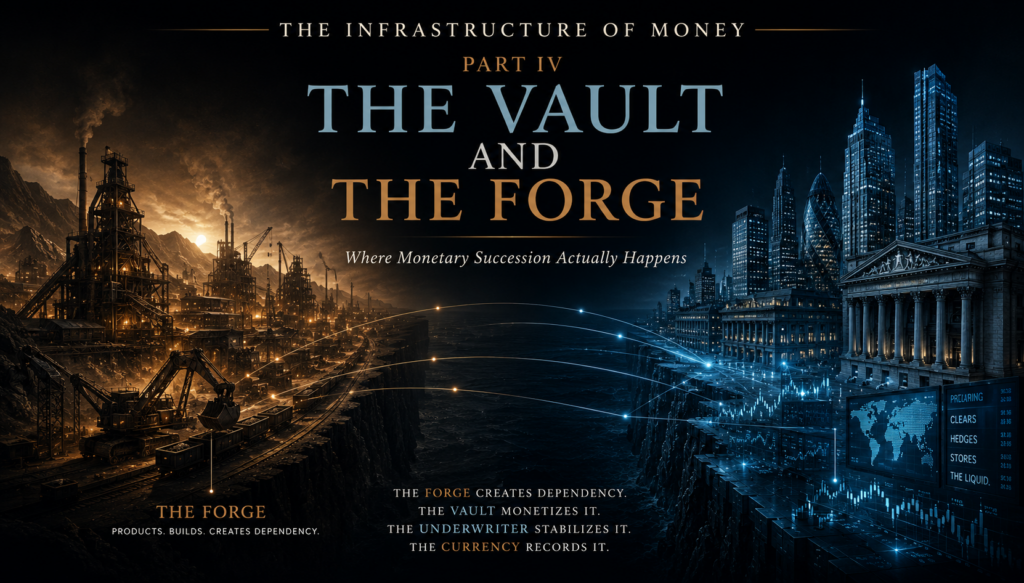
An essay on the missing link in the theory of monetary succession: the financial infrastructure where indispensability is priced, cleared and stored — and what happens when it separates from the productive system that created it.
The Infrastructure of Money
18 min read
July 28, 2026
By Marcelo Gonçalves
Series
The Infrastructure of Money / Part IV / The Vault and the Forge
Prologue: A Correction the Theory Demands
A theory tested in public must be corrected in public.
The three preceding essays in this series proposed a mechanism — the Foundational Asset Theory of Monetary Succession — and applied it to six centuries of monetary history and to the present. The mechanism held. But when the argument was subjected to deliberate adversarial reading, two anomalies emerged from the historical record. They appeared unrelated. They are not.
The first anomaly is Spain. The Real de a Ocho became the first truly global currency, exactly as the theory predicts: a controlled productive system — the mines of Potosí and Zacatecas, the mercury monopoly of Almadén and Huancavelica, the convoy system, the standardized coinage — generated systemic dependency across three continents, and the currency of the controlling economy became the world’s instrument of settlement. And yet Spain never became the financial center of the world it monetized. The deep markets formed in Genoa, in Antwerp, in the exchange fairs of Piacenza. The Crown that issued the world’s money declared bankruptcy four times in a single century — a debtor to the very system its silver fed. The theory, as stated in Part I, predicted that deep liquidity would follow systemic dependency into the controlling economy. In the Spanish case, it did not.
The second anomaly is the interwar period. Part III described the quarter-century between 1914 and 1944 as the historical record’s one prolonged monetary vacancy — and drew comfort from the fact that the heir, at least, was never in doubt. The United States was already the world’s largest industrial economy by the 1890s, already its largest creditor by 1919. But this is precisely the problem. If a visible heir with overwhelming productive dominance stood ready for twenty-five years, why did the vacancy last twenty-five years? The presence of the heir did not shorten the interregnum. Something else was governing its duration.
Here the earlier essays require a correction of record as well as of theory. Part II described the present absence of a successor as without precedent; the prologue to Part III stated that history records no prolonged vacancy. Stated so broadly, neither claim survives the interwar case. The precise formulation — the one this essay will defend — is this: history records one prolonged vacancy, and it occurred with a visible heir. The present moment is the first prolonged vacancy without one. The distinction is not smaller than the original claim. It is the key to the entire problem.
The anomalies emerged four centuries apart. Surfaced by different routes through the historical record, they prove to be manifestations of the same omission — two independent measurements of the same missing variable. In the practice of theory-building, that is not an embarrassment. It is a signal.
This essay names the variable.
“A theory tested in public must be corrected in public.”
The chain required one missing variable.
The chain proposed in Part I ran as follows: foundational assets, organized into a controlled productive system, generate systemic dependency; systemic dependency concentrates financial activity; concentrated financial activity produces deep liquidity; and deep liquidity makes the controlling economy’s currency the preferred instrument of pricing, settlement and savings.
Each link was necessary. None was sufficient alone. But one transition in the chain was treated as automatic — and it is not.
Between systemic dependency and deep liquidity, the theory assumed a direct transmission: because the world must transact with the indispensable economy, the world’s financial activity would gravitate there. Spain demonstrates that the transmission can fail. The world transacted in Spanish silver for two centuries. The world’s financial activity gravitated to Genoa.
The reason is that deep liquidity does not float freely, settling wherever dependency points. It lives inside a physical and institutional structure of its own: exchanges, clearing mechanisms, commercial law, credit networks, insurance markets, the accumulated trust of counterparties who have settled with each other for generations. That structure has properties the theory failed to assign it. It has mass. It has inertia. It is extraordinarily difficult to build, and — the historical record will show — extraordinarily slow to move.
It deserves a name of its own.
Definition
The financial infrastructure where systemic dependency is priced, cleared, hedged and stored — the exchanges, clearing systems, legal frameworks, credit and insurance networks through which the indispensable is converted into the liquid.
Definition
The controlled productive system that generates systemic dependency.
The distinction restates the theory’s central chain with a precision it previously lacked. The forge creates the dependency. The vault monetizes it. And because they are separate structures, they can separate — for decades at a time. When they do, the rents of indispensability flow not to the economy that controls the forge, but to the economy that holds the vault. Spain forged the world’s money and paid interest to Genoa for the privilege.
Monetary succession does not occur when the forge changes hands. It occurs when the vault migrates and reunifies with the new forge. The interregnum — the vacancy Part III described — is not an anomaly of transition. It is the migration time of the vault.
One further variable must be admitted into the chain, because the interwar case forces it there. A vault is not merely a structure. It is operated — and in moments of systemic stress, it must be deployed. Charles Kindleberger, examining the Depression, compressed the interwar failure into a single asymmetry: Britain could no longer act as the system’s underwriter, and the United States would not. The capacity existed. The will did not. For a decade, the world’s forge and an increasingly large share of its financial capacity sat in an economy that declined to underwrite the system running on them — and the historical price of that refusal was paid by everyone.
“The forge creates the dependency. The vault monetizes it. Succession occurs when the two reunify.”
Definition
The political willingness of the vault’s holder to provide liquidity, absorb external imbalances and preserve systemic stability in moments of systemic stress — even at domestic cost.
The theory as stated in Parts I through III was materialist: assets generate dependency, dependency generates money. The correction is not to abandon that structure but to complete it. Between the vault and the crown stands a choice — the willingness of the vault’s holder to underwrite the system in crisis. Political scientists have debated for forty years whether that underwriting function requires a single hegemon at all, or whether institutions can perform it cooperatively — the question that divides Kindleberger’s account from Robert Keohane’s After Hegemony. The earlier essays in this series implicitly assumed Kindleberger’s answer without ever isolating the question. The final sections of this essay must isolate it — and answer it.
One clarification prevents a confusion that the vocabulary might otherwise invite. Institutions appear at two different places in this architecture, and they are not the same thing. Some institutions are constitutive of the vault — the clearing systems, the settlement networks, the commercial law, the exchanges. They are not connectors between the links; they are the material substance of one of them. Other institutions are coordinative — the treaties, the funds, the standing conferences through which the underwriter’s willingness is exercised, extended and legitimized. Bretton Woods did not build America’s vault; it institutionalized America’s will to deploy it. This distinction carries a provisional answer to the Kindleberger–Keohane question: coordinative institutions can stabilize and prolong an underwriter’s commitment, but the historical record has yet to show that they can originate one without an underwriter behind them.
The chain, then, in its completed form — stated in full once, here:
Technological paradigm → foundational assets → the forge → systemic dependency → the vault → the will to underwrite → reserve currency.
The chain obeys a single governing rule. Call it the Principle of Sequential Contingency: each link creates the conditions for the next; none compels it. Spain built a forge whose dependency never delivered it the vault. London held a vault that outlived its forge by two generations. The United States possessed both forge and vault for a decade before it consented to underwrite anything. China is assembling a forge while declining to build the vault. Every difficult case in six centuries of monetary history is a case of one link failing to produce the next automatically — and the first three essays of this series, which treated the transmission as automatic, could explain none of them fully. This principle is what they were missing.
For the reader meeting six new terms at once, the chain can also be read as answering four progressively narrower questions. What changes? The paradigm. What becomes indispensable? The forge. Where is that indispensability monetized? The vault. Who chooses to stabilize the system? The underwriter. The currency is not a fifth question. It is the record of the four answers.
The first link is new to the diagram but not to the series: Part I already observed that technological revolutions periodically redefine what the global order cannot function without. The paradigm selects the foundational assets; the assets, organized and controlled, become the forge. What Part II examined — artificial intelligence, energy, computation, critical materials — was never the forge itself. It was the paradigm choosing the assets from which the next forge will be built.
Naming that link places this theory in a neighborhood it must acknowledge. Carlota Perez has shown that technological revolutions periodically decouple financial capital from productive capital within economies, and recouple them as each paradigm matures. The mechanism described here is adjacent but answers a different question. Perez explains why productive and financial capital periodically decouple within technological revolutions. The Foundational Asset Theory asks what happens next at the level of the international order: once that decoupling occurs, what determines where the global monetary architecture ultimately reconverges? Her subject is the rhythm of the decoupling. Ours is the geography of the reunion.
The principle also has a tempo — and the tempo explains the shape of every succession this series has examined. Every link possesses inertia, except one. Paradigms shift over generations; forges are built over decades; dependency accumulates transaction by transaction; and the vault, as the following sections will show, is the slowest-moving structure in the entire architecture. But the will to underwrite is the fast variable in a slow system. The United States moved from isolationist refusal to full underwriter in under five years; it has moved from underwriter toward weaponizer in under a decade. This asymmetry yields the rhythm of monetary history: successions take decades because the vault migrates slowly — and they conclude abruptly because the will can commit in a single conference.
“Thirty years of migration; three weeks at Bretton Woods.”
Three additions to the chain of Part I, each paid for by something the shorter version could not explain: the paradigm, by the continuity of this series’ own argument; the vault, by Spain; the will, by the interwar years. And beneath all three, the principle that governs them — sequential contingency, the rule the first three essays assumed away.
The completed statement of the theory can now be compressed into four sentences. Foundational assets explain the forge. The forge explains dependency. The vault explains monetary persistence. Together, they explain monetary succession.
What remains is to test the corrected chain against the record — against Spain and Portugal, where the forge never captured the vault; against Amsterdam and London, where the vault outlived the forge by half a century each; against the migration of 1914–1944, which the corrected theory transforms from an unexplained vacancy into a measured one; and against the present, where the vault sits in full strength in an economy whose forge is eroding, while the forge of the next era is being assembled by economies that either cannot or will not build a vault to match it.
That configuration has appeared in the record before. Twice. Both times, it marked the late phase of a monetary order — not the early phase of its renewal.
“The interregnum is not an anomaly of transition. It is the migration time of the vault.”
Reserve status always carries a structural cost.
In 1960, Robert Triffin told the United States Congress that the dollar’s global role contained a structural contradiction: to supply the world with its money, America would have to send the world its money — running the permanent external deficits that would, over time, erode confidence in the very currency the world demanded. Part I of this series presented the dilemma as the rent paid for the crown.
This section makes a stronger claim. Triffin did not discover that mechanism. He named its fiduciary form. The mechanism itself is at least four centuries older than its name — and the first economy to pay the cost in full was the one that issued the first global currency.
The demonstration begins — as every historical section of this essay now will — not with the economy, but with the paradigm. The Columbian voyages did not merely extend Europe’s geography. They transformed the monetary substrate of the global economy: for the first time, continents that had never settled accounts with one another required a common instrument, at a scale no existing mint or metal supply could provide. The paradigm selected the era’s foundational asset — standardized metallic liquidity — before any Spaniard chose it. Spain did not choose the paradigm. It chose to organize it. The paradigm came first; the forge came second — and that ordering, established here, repeats in every case that follows.
Consider, then, what reserve status meant under commodity money. A fiduciary issuer supplies the world with liquidity by exporting claims — deficits, debts, promises. A commodity issuer has no such option. For the Real de a Ocho to function as the settlement instrument of a newly connected planet, the silver itself had to leave Spain — physically, permanently, in fleets. Every peso monetizing trade in Antwerp, Manila or the Ming tax system was a peso that no longer circulated in Castile. The hemorrhage was not mismanagement. It was the job description. An economy whose money is the world’s money must bleed its money into the world.
Definition
The structural export of the monetary medium that reserve status imposes on its issuer — specie hemorrhage under commodity money, external deficits under fiduciary money — and the erosion of the domestic productive base that follows in either regime.
The correspondence is not a metaphor. It is a structure, visible when the two regimes are set side by side:
Figure
Commodity Regime — Spain
Fiduciary Regime — United States
How the world is supplied
Export of silver
Export of dollar claims
The form of the outflow
Monetary metal physically leaves
Permanent current-account deficits
The domestic cost
Price revolution; Castilian deindustrialization
Triffin dilemma; manufacturing erosion
Who bears it
The issuer of the world’s coin
The issuer of the world’s reserve
The table does not claim the two cases are identical. It claims the structural logic is the same — and that the logic is a property of the crown, not of the century.
And the erosion followed. The influx and outflow of American treasure drove the price revolution that made Castilian goods uncompetitive across European markets; the workshops of Segovia and Toledo decayed while Spanish demand was supplied by Dutch, English and French manufactures — paid for in Spanish silver. Between roughly 1560 and 1620, the economy that issued the world’s money progressively ceased to make the things the world bought. Economists would later call this pattern the Dutch disease, after a twentieth-century case. It deserves an older name. Castile contracted it first — and contracted it not from oil or gas, but from the burden of minting civilization’s currency. The deindustrialization of Castile between 1560 and 1620 and the deindustrialization of the American manufacturing base between 1980 and 2020 are not analogous events. They are the same structural mechanism, executed twice — once in specie, once in claims.
“An economy whose money is the world’s money must bleed its money into the world. Triffin named the mechanism. Spain paid for it first.”
None of this diminishes what Spain built. Measured against the corrected chain, the Spanish forge was complete and formidable: the mines of Potosí and Zacatecas; the mita labor system that manned them; the Casa de Contratación’s monopoly port at Seville; the escorted convoy system that moved more precious metal across more ocean than any polity had ever attempted; and the mints whose standardized coinage was trusted from Amsterdam to Manila precisely because no rival could match its consistency at scale. Above all, Spain controlled the era’s true choke point — not the silver, but its processing. The amalgamation process that made low-grade American ores economical required mercury, and the crown held the only two sources that mattered on Earth: Almadén in Iberia and Huancavelica in Peru. A refining monopoly at the base of the world’s monetary supply chain. The reader tracking the present transition may pause at that sentence; this essay will return to it.
The dependency was equally real. By the 1580s, the Ming empire had reorganized its entire fiscal system around silver it did not mine — silver that arrived, in large part, on the Manila Galleon. The forge generated systemic dependency across three continents, exactly as the theory predicts. The chain held, link by link — until the vault.
Because the vault was never Spanish. The deep markets where Spanish silver was priced, lent, hedged and multiplied formed in Genoa, in Antwerp, and in the exchange fairs the Genoese operated at Besançon and then Piacenza — the clearing house of European finance, where the paper claims on Seville’s treasure changed hands months before the fleets arrived. The Crown did not command this system. It borrowed from it, through the short-term asiento contracts that converted future silver into present armies. When the treasure was delayed, Castile did not draw on its own financial depth, because it had none to draw on. It defaulted — in 1557, 1560, 1575 and 1596, four bankruptcies in a single reign, each one a negotiation in which the issuer of the world’s money petitioned its own creditors for terms.
Two details expose the structure completely. The first: for much of the century, the Almadén mercury mines — the choke point of the entire monetary supply chain — were administered by the Fugger banking house as collateral for loans the Crown could not otherwise service. Spain had mortgaged the base of its forge to the holders of someone else’s vault. The second: when the 1575 bankruptcy froze Genoese credit, the unpaid Army of Flanders mutinied and sacked Antwerp — the Spanish Fury of 1576. The vault had merely closed its window; the forge’s own soldiers did the demolition. Contemporaries understood what historians would later formalize. Quevedo set it in verse within a generation: silver is born honored in the Indies, comes to die in Spain — and is buried in Genoa.
“Spain had mortgaged the base of its forge to the holders of someone else’s vault.”
Portugal removes the last available objection. Spain, standing alone, might still be dismissed as exceptional — one polity’s fiscal mismanagement dressed up as structure. Portugal makes that reading impossible, because it ran the same experiment independently, with even cleaner results. The Casa da Índia held a crown monopoly on the richest trade route on Earth — the pepper and spices of the Carreira da Índia. Yet the monopoly’s proceeds were realized at the feitoria in Antwerp, financed in advance by the Fuggers, the Welsers and Italian syndicates, on credit terms the Crown could never escape. Lisbon controlled the ships, the forts, the route and the product, and captured a fraction of the margin; the financiers of Antwerp and Augsburg, who never rounded the Cape, captured the rest. Forge without vault — in a form so pure it barely needs interpretation.
The theoretical yield of the Iberian century can now be stated precisely. The original chain of Part I predicted that Spain’s systemic dependency would concentrate deep liquidity in Spain. It did not — and the older theory had to treat the era’s defining monetary power as an awkward partial fit. The corrected chain predicts exactly what occurred: a complete forge generated a global currency and sovereign fragility simultaneously, because the rents of indispensability flow to the vault, wherever it stands. Spain was therefore not an exception. It was the first recorded separation between the forge and the vault — and it demonstrates not one but two structural properties of monetary succession. It paid the Cost of the Crown four centuries before Triffin named that cost’s fiduciary form. And it paid it while financing a vault it never controlled. The method of this essay follows from that result: the theory does not draw analogies between centuries. It identifies the symmetries that a single mechanism, running more than once, necessarily produces.
“Controlling what the world cannot do without is sufficient to create dependency. It is not sufficient to capture the rents that dependency generates.”
The vault can persist after the forge has moved.
Spain demonstrated the separation in one direction: a forge that never captured the vault. Symmetry demands the inverse experiment. Can a vault survive the loss of its forge — and for how long, and at what price to the theory of succession? History ran that experiment twice before running the migration that ended it. The protocol is the same as before: paradigm first.
The paradigm of the seventeenth century, as Part I established, was organizational scale — the joint-stock company, the exchange, the clearing bank. The Dutch built the forge of that paradigm and, uniquely among the cases in this series, built the vault beside it in the same city: the Wisselbank’s bank money became the reference unit of European commerce, and Amsterdam’s capital market became the place where sovereigns borrowed. Then the forge died — and the vault did not notice for two generations. Through the eighteenth century, British and French shipping outbuilt the Dutch fleet, Dutch manufacturing decayed, and the Republic’s commercial primacy dissolved in wars it could no longer afford. Yet Amsterdam remained the financial capital of Europe into the 1780s. Its most striking client was its own successor: Dutch investors held a substantial share of Britain’s national debt — by some estimates approaching a third — meaning the rising forge industrialized on credit drawn from the fallen forge’s vault. Let the record note what Part III’s prologue, compressing the lineage, omitted: the guilder belongs in the succession between the Real de a Ocho and sterling, and its afterlife is not a curiosity. It is the first measurement of the vault’s inertia — roughly half a century between the loss of productive primacy and the loss of financial centrality.
The British case repeats the measurement with better instruments — and forces this series to correct itself a second time. Part I named the foundational asset of the British era “industrial capital.” That label is accurate for the first half of the era and wrong for the second, and the difference is the whole point. By the 1890s, American steel output had passed Britain’s; German chemistry and electrical engineering led their fields; the productive constraint of the second industrial revolution was being solved in Pittsburgh and the Ruhr. The forge had moved. Under the original chain of Part I, sterling should have entered decline in the 1890s. Instead, the years from 1870 to 1913 were sterling’s absolute apogee — the highest share of world trade ever financed in one currency, before or since.
The resolution is that the British foundational asset had migrated within the era — from the mill to the City. What the world could not do without in 1900 was no longer British manufacturing. It was the British vault: the acceptance market that financed the majority of world trade including trade that never touched a British port; Lloyd’s, which priced the ocean’s risk; the merchant marine and the cable network that moved the goods and the information; and the imperial balancing wheel — India above all, whose surpluses with the world and deficits with Britain closed the system’s accounts and made the gold standard function. The empire mattered decisively, but not as a factory. It mattered as the territorial mode of controlling a clearing network.
Definition
Control of indispensable systems has taken two historical forms: coercive-territorial — sovereignty over the sources and routes themselves — and institutional-commercial — ownership of the organizational and financial architecture through which others’ production is priced and cleared.
Note what this case establishes for the theory’s general claims. The productive constraint of the world economy shifted decades before its money did — and no succession followed the shift alone. Part II asserted that the binding constraint of growth is changing now “for the first time since the Industrial Revolution.” Stated so broadly, that was wrong: the constraint has shifted before, and the 1890s are the proof. What did not shift in the 1890s was the vault. Constraint changes are necessary but never sufficient; they open successions without executing them. The execution is the vault’s migration — and that is what the next thirty years supplied.
The migration can be dated with unusual precision. The forge crossed the Atlantic around 1890. The vault began crossing in August 1914, when war forced Britain to liquidate its overseas assets and borrow in New York; by 1919 the United States was the world’s creditor. The crossing then took a full generation, and the reasons are the anatomy of vault inertia. New York had capital but not architecture: no acceptance market until the young Federal Reserve deliberately built one; thinner legal and institutional depth in trade finance; no accumulated counterparty trust. Through the 1920s and 1930s the two vaults seesawed — the dollar overtaking sterling as a reserve unit, sterling recovering after 1931 behind its currency area — a literal oscillation of the vault between shores, documented in the reserve records of the period. And above all, the fast variable stood at refusal. The heir held the forge and, increasingly, the capacity of the vault — and would not underwrite. Section I named the consequence and the price. The interwar catastrophe was not the absence of an heir. It was the presence of an heir whose will had not moved.
This is the finding that dissolves the puzzle Part III could describe but not explain. The heir’s visibility did not shorten the vacancy, because visibility is not the operative variable. Reunification is. The vacancy of 1914–1944 lasted exactly as long as the vault’s migration plus the will’s refusal — and it ended the moment both completed, with a speed that only the fast variable can supply. Lend-Lease turned the will in 1941; the institutions followed; and the migration that had consumed thirty years was formalized in the three weeks of July 1944. The interregnum was never a mystery. It was a measurement.
“The interwar vacancy was not the absence of an heir. It was the presence of an heir whose will had not moved.”
The generalization, in the protocol’s final movement, now writes itself. Twice in the historical record, the vault has outlived its forge — by roughly sixty years in Amsterdam, by roughly fifty in London. In both cases the world’s money answered to the vault, not the forge, for the duration of the separation. In both cases the separation ended only through reunification — the vault migrating to where the new forge stood — and the reunification required both the slow variable to complete its crossing and the fast variable to consent. The law this essay proposed in its first section has now been tested against every difficult case in the six-century record: Spain, where the forge never won the vault; Amsterdam and London, where the vault reigned after the forge; and the interwar decades, where the migration between them could be measured in years and paid for in depressions.
One configuration from that record remains to be examined — and it cannot be examined in the past tense. An economy holding the world’s vault at full strength, while the paradigm assembles a new forge that this economy does not fully control: the record contains exactly two prior instances of that configuration. Amsterdam around 1750. London around 1913. Both were the late phase of a monetary order, and neither knew it at the time.
Where the vault stands now — and whether the will that operates it is extending the order or ending it — is the question of Part V.
“Twice, the vault has outlived the forge by half a century. Both times, the world’s money answered to the vault. Both times, it was the late phase.”
Series Navigation
[Editor’s note: Part IV incorporates corrections of record to Parts II and III, identified in the course of adversarial review: the interwar period constitutes a prolonged vacancy with a visible heir (revising “without precedent” in Part II, §VI); the guilder is restored to the succession lineage (revising Part III, Prologue); and the productive constraint has shifted before without producing succession (revising Part II, §II). The theory as revised in this essay explains why each earlier formulation required correction.]