Physical Address
304 North Cardinal St.
Dorchester Center, MA 02124
Physical Address
304 North Cardinal St.
Dorchester Center, MA 02124

Essay
The Test
Series / Part II / The Test
The Infrastructure of Money
12 min read
July 6, 2026
By Marcelo Gonçalves
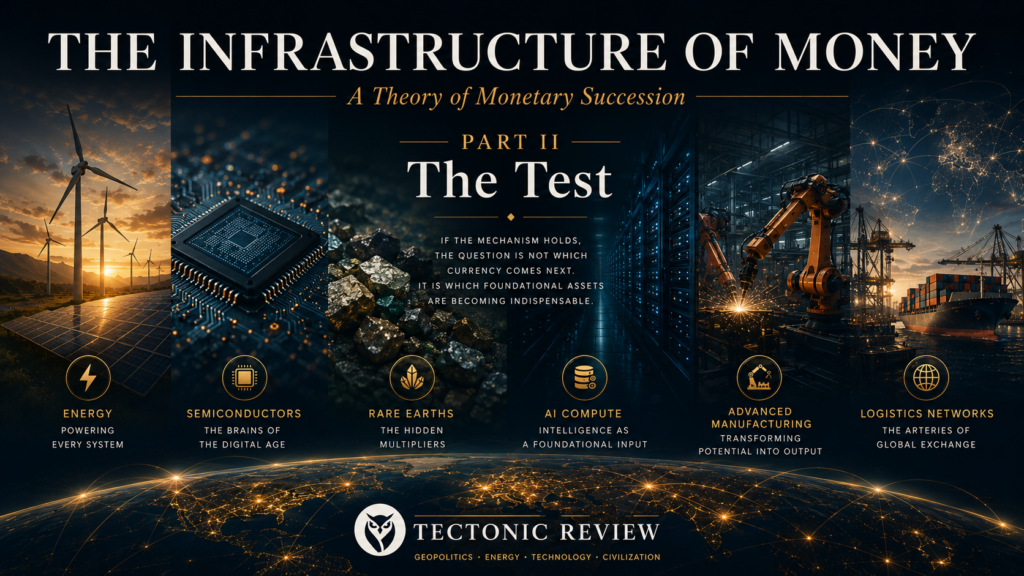
A test of the theory: whether a successor to the dollar is actually being assembled in the emerging productive architecture of the twenty-first century.
Series
The Infrastructure of Money / Part II / The Test
Prologue: The Great Misidentification
Throughout history, great powers have consistently made the same mistake. They have confused the symbol of their strength with its source.
Spain believed its power came from silver. The treasure fleets crossing the Atlantic were, to Spanish eyes, the engine of empire. But silver was not the source — it was the output. What made Spain indispensable was its control over the only system capable of connecting European capital with American resources at continental scale. When that system was superseded, the silver continued to flow for a time. The power did not.
Britain believed its strength resided in the Royal Navy. The fleet was real, and formidable. But the Navy existed to protect something larger: an industrial and commercial architecture that had made Britain the organizing center of global manufacturing, finance and trade. When that architecture lost its singular position, the Navy remained. The monetary order did not.
Today, a version of the same confusion is visible in how many analysts discuss American power. The dollar, Wall Street, the Federal Reserve — these are frequently described as the foundations of American hegemony. The Foundational Asset Theory proposed in Part I suggests a different reading: they are its most visible consequences.
Every previous transition had something the present one appears to lack.
A theory that cannot be tested is not a theory. It is a narrative.
The mechanism described in Part I makes a specific claim: monetary orders emerge from controlled productive systems that generate systemic dependency, and they erode when that dependency gradually diminishes. If this mechanism is real, it should produce observable consequences — not in exchange rates or central bank reserves, but in the underlying structure of the global productive order.
What should we observe if the theory is correct?
We should observe a shift in the productive bottlenecks of the global economy — a transition in which some previously abundant inputs become scarce and strategically contested. We should observe a reorientation of geopolitical competition toward the control of those inputs, not merely toward territory or markets. We should observe massive concentrations of investment flowing toward the industries that process and deploy them. And we should observe, in the behavior of states and firms alike, an implicit recognition that access to certain systems is no longer a matter of commercial preference but of structural necessity.
Definition
The limiting factor that constrains the growth of an emerging productive system and therefore reveals the next foundational asset.
The global economy in the mid-2020s displays all of these symptoms simultaneously.
Geopolitical competition has reorganized itself around semiconductors, rare earth minerals, electricity generation capacity and artificial intelligence infrastructure — categories that would have seemed peripheral to power two decades ago. Export controls, industrial policy, strategic reserves, alliance structures: the vocabulary of great-power rivalry has quietly shifted from geography toward productive infrastructure. Wars are being fought over energy corridors. Alliances are being renegotiated around chip supply chains. Investment in electricity generation, battery technology and computing infrastructure has reached levels not seen since the postwar reconstruction era.
The theory predicts this pattern. The broad reorientation of strategic competition toward productive infrastructure — rather than toward the financial instruments built on top of it — is precisely what the model would lead one to expect at the beginning of a transition in foundational assets.
“The broad reorientation of strategic competition toward productive infrastructure is precisely what the model would lead one to expect at the beginning of a transition in foundational assets.”
History does not choose foundational assets. Productive constraints reveal them.
No civilization decided that maritime connectivity would be foundational in the fifteenth century. No government decreed that metallic liquidity would organize global trade in the sixteenth. No treaty established that industrial capital would define monetary power in the nineteenth. In each case, the productive system of the era encountered a binding limit — something without which growth halted, trade stalled, or the system itself ceased to function — and the economy that controlled the solution to that bottleneck became indispensable.
Definition
A productive input whose scarcity or irreplaceability determines the limits of economic expansion.
The right question, therefore, is not: which assets will matter in the twenty-first century? It is: what is the global productive system finding increasingly difficult to replace?
To answer it, we need to follow the constraint.
For most of recorded economic history, the binding limit on production was human labor. Land, capital and resources were important, but their value was ultimately determined by the human capacity to deploy them. Population growth translated into productive growth. The size of a workforce set the ceiling on what an economy could produce.
That relationship is being structurally altered. The deployment of artificial intelligence across production, logistics, services and scientific research is progressively reducing the role of human labor as the primary limiting factor in economic output. This is not a prediction about a distant future; it is a description of a process already underway, visible in the productivity trajectories of early-adopting industries and in the investment flows reorganizing global supply chains around automation.
When labor ceases to be the structural limit, something else becomes the bottleneck. And that something else is not abstract.
Automated production systems require electricity — in quantities that are transforming energy infrastructure from a background assumption of economic life into an actively contested strategic resource. A single large-scale AI training run now consumes energy comparable to a small city. The global buildout of data center infrastructure has made electricity generation capacity a primary variable in industrial location decisions, investment strategies and national competitiveness assessments.
Yet generation alone is insufficient. Transmission infrastructure, grid stability and transformer capacity are rapidly emerging as productive bottlenecks of comparable strategic importance. The ability to deliver reliable, high-density power to large computational facilities — not merely to produce it — is increasingly what separates economies capable of hosting the next productive architecture from those that are not. The transition toward electrification redistributes but does not eliminate influence over the marginal cost of energy: the producers who shaped the fossil-fuel era are already repositioning within the emerging one, ensuring that energy remains a foundational variable regardless of its source.
Automated systems also require computational infrastructure — semiconductors manufactured at scales of precision that only a handful of facilities in the world can achieve, and deployed within architectures that are themselves the product of decades of concentrated research investment. The dominance of this infrastructure extends beyond physical fabrication: the design software, intellectual property frameworks and specialized equipment that make advanced chip production possible constitute a layered system of productive control that is, in aggregate, even harder to reproduce than any single factory.¹ The geographic concentration of advanced chip manufacturing in Taiwan, and of the lithographic equipment required to produce it in the Netherlands, has transformed what was once an industrial supply chain into a geopolitical pressure point of the first order.
And automated systems require materials that are neither abundant nor easily substituted. Lithium, cobalt, nickel, rare earth elements, copper in quantities the existing mining industry was not designed to supply — these are the physical substrate of the energy transition and the computational revolution simultaneously. Their extraction and, crucially, their refining and processing into usable industrial inputs have emerged as structural bottlenecks in the productive system the global economy is attempting to build.
For the first time since the Industrial Revolution, the binding constraint of economic growth is shifting. That observation matters far beyond economics. History suggests that when the productive bottleneck changes, everything built upon it eventually changes as well — including, in time, the monetary order that rests upon it.
“For the first time since the Industrial Revolution, the binding constraint of economic growth is shifting.”
Money has never been the exception.
In every previous transition examined in Part I, the emerging foundational assets were, or rapidly became, organized into a controlled productive system by a single dominant economy. Venice did not share control of Mediterranean commercial routes with a consortium of rivals. Britain did not co-manage the industrial capital system with France and Germany. The United States did not distribute the postwar security and reconstruction architecture across a committee of equals.
Concentration of control was not incidental to monetary succession. It was structural. Systemic dependency requires a system that others cannot easily reproduce. A system controlled by no one in particular generates competition, not dependency.
The present distribution of emerging foundational assets looks unlike any previous transition.
The United States controls the upper layers of the artificial intelligence system: the frontier model research, the dominant platforms, the semiconductor design ecosystem, and the financial and institutional infrastructure that supports it. China controls the processing and refining of a significant share of the world’s critical minerals, the manufacturing of batteries and solar panels at scales no other economy currently matches, and an increasingly competitive domestic AI ecosystem. Taiwan controls the fabrication of the most advanced semiconductors on Earth. ASML, a Dutch company, controls the only machines capable of manufacturing the equipment needed to produce those chips. Saudi Arabia and a small number of Gulf states retain decisive influence over the marginal cost of global energy.
Does any economy control the assets? Partially. Several do, each over a different portion of the emerging architecture.
Does any economy control the system? No.
The integrated productive system that would need to exist — one whose control would generate the kind of systemic dependency that historically precedes monetary succession — does not yet belong to anyone. It is still being assembled, contested and negotiated simultaneously across multiple capitals whose industrial and strategic decisions are reshaping the global productive order in real time.
“Fragmentation may itself be the defining characteristic of this transition.”
The question that follows is the most important one the theory raises.
The Foundational Asset Theory provides a specific set of criteria for evaluating candidates for monetary succession. Not size. Not military power. Not diplomatic influence. The question is whether a candidate controls an integrated productive system built around the emerging foundational assets, organized in a way that generates systemic dependency.
Measured against those criteria, the current field looks as follows.
Criterion
United States
China
Euro Area
BRICS
AI ecosystem
Advanced and largely integrated
Advanced, partially integrated
Developing, fragmented
Nascent, fragmented
Critical minerals
Limited domestic, strong allied network
Strong in refining and processing
Limited
Fragmented across members
Compute infrastructure
Strong and dominant
Strong and growing
Moderate
Limited
Energy position
Strong, increasingly electrified
Import-dependent, rapidly investing
Import-dependent
Mixed, uncoordinated
Global financial depth
Dominant
Developing, capital-controlled
Strong, structurally fragmented
Limited
Systemic dependency generated
High, established
Growing, concentrated in trade
Regional
Minimal
Integrated system sufficient for succession
Incomplete
Partial
No
No
The table is not a ranking. It is a description. Two candidates warrant closer examination, because the structural limits that disqualify them are not fully visible in the table alone.
China presents the most analytically interesting case. Its productive capacity across several foundational categories is formidable and has been assembled with unmistakable strategic intent. Yet the structural closure of its capital account — the deliberate decision to prevent the free movement of the renminbi across borders — disqualifies it from the monetary role its productive weight might otherwise suggest. A currency that cannot be freely held, traded and moved is a currency that cannot become the instrument through which the global economy settles its accounts. This is not a market judgment on China’s strength. It is a structural condition that China has chosen to maintain, for reasons of domestic financial control that the historical record of monetary succession does not accommodate.
The Euro area presents a different limiting factor. Its financial markets are deep, its institutions are sophisticated, and the euro is the second most widely held reserve currency in the world. But the Euro area remains, in the terms of the theory, a currency without a country — and more precisely, without the unified productive, fiscal and security architecture that has underwritten every previous reserve currency. Twenty economies share a unit of account without sharing the integrated system that monetary dominance has historically required. The sovereign debt crisis of 2009 to 2012 demonstrated the structural limits of that arrangement with unusual clarity.
“The conclusion is not that the dollar is secure. It is that no candidate has yet assembled the integrated productive system that monetary succession has historically required.”
The road is still the road. Only the vehicle has changed.
At this point in the argument, a familiar objection arises.
Perhaps the next monetary order will not emerge from a state at all. Perhaps digital currencies — stablecoins, central bank digital currencies, or some form of decentralized monetary infrastructure — will dissolve the historical connection between productive systems and reserve currencies.
The objection deserves a direct answer.
Stablecoins, in their current and foreseeable form, change the vehicle. They do not change the road.
A stablecoin denominated in US dollars — which describes the overwhelming majority of stablecoins by market capitalization — does not challenge the dollar’s role in the monetary order. It extends it. Every dollar-denominated stablecoin in circulation is, in effect, a demand for dollar liquidity, a vote of confidence in the productive system the dollar represents, and a deepening of the network effects that sustain dollar dominance. Far from threatening the existing order, dollar stablecoins may be one of the more powerful mechanisms for extending it into digital financial infrastructure.
A stablecoin denominated in a different unit of account faces precisely the same structural limit as any other challenger currency: its credibility ultimately derives from the foundational assets and systemic dependency that back the economy issuing it. A digital yuan is still a yuan. Its monetary properties are determined not by its technology but by the productive system behind it, and by the degree to which the global economy has become dependent on that system in ways it cannot easily replace.
The technological layer of money has always evolved. Coins gave way to paper. Paper gave way to electronic ledgers. Electronic ledgers are giving way to programmable digital instruments. Each of these transitions changed the mechanism of monetary exchange. None changed the underlying logic of monetary succession.
“Stablecoins change the vehicle. They do not change the road.”
The money, as it has always been, will arrive last.
The historical pattern examined across six centuries in Part I had, until now, one consistent feature: when a monetary order began to show signs of strain, a successor was already visible. Not always acknowledged, not always welcome, but structurally present — already accumulating the foundational assets that the next era would depend upon, already generating the systemic dependency that would eventually demand a new monetary expression.
That feature is absent from the present transition in a way that is, by the standards of the historical record, without precedent.
The dollar’s position is under strain. Fiscal trajectories test the limits of what reserve currency status can absorb. Central banks have gradually reduced their dollar holdings. The geopolitical weaponization of dollar-clearing infrastructure has accelerated de-dollarization incentives across a significant portion of the global economy. None of this should be dismissed.
But when the Foundational Asset Theory is applied as a diagnostic rather than a predictive tool, the conclusion is not that the dollar is collapsing. It is that no economy has yet assembled the integrated, controlled productive system across the emerging foundational assets that would qualify it, by the historical standard, as a successor.
The throne is not merely contested. In the specific sense that the theory defines — a controlled productive system generating irreplaceable systemic dependency — it is still being built.
This may be the defining feature of the present monetary moment: not a transition in progress, but a transition suspended between the erosion of an old productive architecture and the consolidation of a new one. The dollar persists not because the productive system that created it remains dominant in all the ways it once was, but because the productive system that would justify a successor has not yet been fully assembled or claimed.
Historians may eventually describe the transition from the dollar to whatever comes next through treaties, exchange rates and central bank decisions. They will write about the moment a new currency achieved reserve status, or the agreement that formalized a new monetary architecture, or the crisis that forced an accelerated reorganization.
History suggests they will be looking in the wrong place.
The transition, if it has already begun, started much earlier — in the laboratories developing frontier AI models, in the mines extracting lithium and rare earth elements, in the semiconductor fabrication facilities determining the physical limits of computation, in the decisions about electricity grid architecture being made today in a hundred countries simultaneously. The question is whether we will recognize the new architecture before the money that reflects it arrives.
“The money, as it has always been, will arrive last.”
Series Navigation
[Part 2 of a series. Part 3 will examine what happens when the world operates for a prolonged period without a clear successor — a condition that monetary history may have never faced before.]