Physical Address
304 North Cardinal St.
Dorchester Center, MA 02124
Physical Address
304 North Cardinal St.
Dorchester Center, MA 02124

Essay
The Empty Throne
Series / Part III / The Empty Throne
The Infrastructure of Money
12 min read
July 16, 2026
By Marcelo Gonçalves
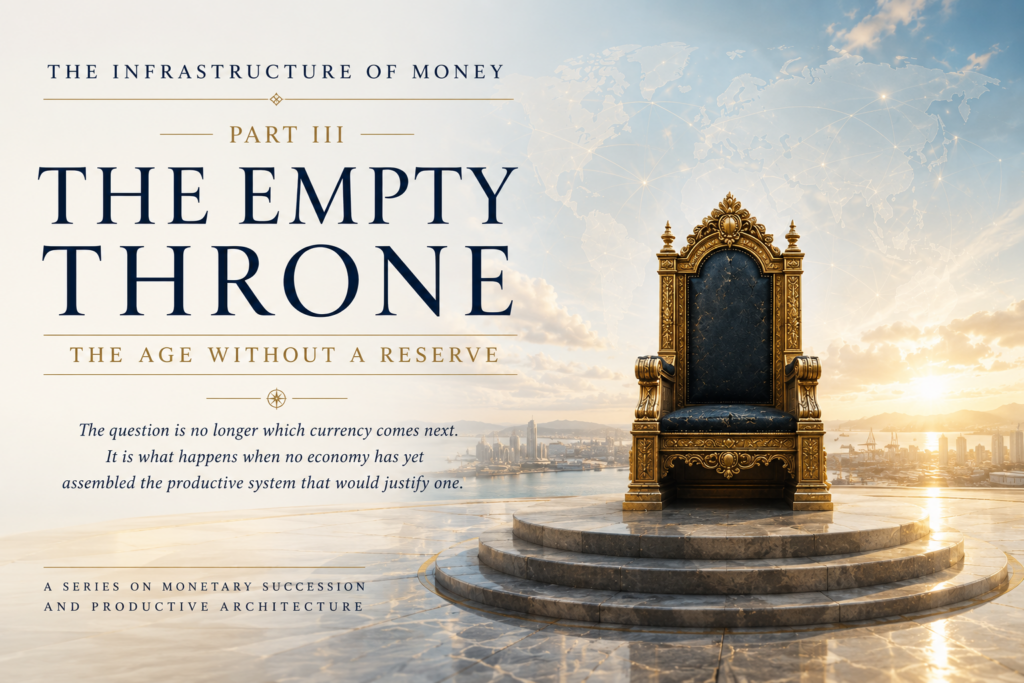
A meditation on monetary succession without a successor, and on the costs of a global order whose coordinating center has not yet been replaced.
Series
The Infrastructure of Money / Part III / The Empty Throne
History records many monetary transitions.
It records no prolonged vacancy.
The passage from one reserve currency to the next has always been, in the historical record, a transfer — not an interruption. The florin gave way to systems that absorbed its function. The Real de a Ocho was superseded by sterling, which was itself superseded by the dollar. In each case, the transition was disorderly, contested and often painful. But it was a transition between anchors, not a departure from the principle of anchorage itself.
What the Foundational Asset Theory described in Part I has revealed, when applied to the present in Part II, is something the historical record has not previously had to account for: a moment in which the old productive architecture is losing its singular capacity to anchor the global monetary order, while the new architecture — energy, computation, critical materials, artificial intelligence infrastructure — remains too fragmented, too contested and too unevenly controlled to consolidate a successor.
This is not a prediction of collapse. Monetary systems do not collapse in the way that bridges do. They degrade, adapt, fragment and reconstitute themselves through mechanisms that often become visible only in retrospect.
But degradation has costs. Adaptation has limits. And the question that the present moment poses — one that six centuries of monetary history have not posed before — is what happens to the global economic order when the vacancy is not brief.
“Every previous transition had an heir. The present moment may not.”
The clearest illustration of what a monetary interregnum costs is the one the twentieth century actually experienced.
The decline of sterling as the world’s reserve currency was not a sudden event. It was a protracted erosion that spanned roughly a quarter of a century, from the disruptions of the First World War through the formal institutionalization of dollar dominance at Bretton Woods in 1944. During that interval, the global monetary system operated without a clearly effective anchor. Sterling was no longer capable of performing its organizing function with the confidence it once commanded; the dollar had not yet assumed it formally.
The consequences were not abstract. The interwar period produced the most severe contraction in global trade since the Industrial Revolution, a cascade of currency crises and competitive devaluations, the effective collapse of the gold standard as a coordinating mechanism, and a geopolitical environment in which the absence of monetary leadership contributed, alongside other forces, to the conditions that made catastrophic conflict possible.
The critical observation is not that the interregnum caused all of these outcomes. It is that the absence of a credible monetary anchor removed one of the mechanisms through which global economic coordination had previously been maintained — and that its absence was felt most acutely not in financial markets but in the real economy, in the trade flows, investment decisions and institutional arrangements that depend on a stable monetary foundation.
Every previous transition had something that shortened the vacancy: an heir already present, already accumulating the productive capacity and institutional depth that the next era would require. The United States in the 1920s and 1930s was already the world’s largest creditor economy, already the dominant industrial power, already the natural center of gravity for a postwar reconstruction that everyone could see was eventually coming. The transition was painful. The heir was never in doubt.
The present moment differs in precisely this respect — and the difference raises a question the historical record cannot answer.
History suggests that every monetary transition eventually produces an heir. But history teaches only what has already happened. The present transition raises a possibility that the six centuries examined in this series have not previously posed: perhaps the mechanism is merely incomplete, and a successor productive architecture is still consolidating from a fragmented starting position. Or perhaps the productive architecture of the twenty-first century possesses characteristics unlike those of any previous era — characteristics that may delay monetary succession indefinitely, or transform it into something the historical record does not recognize.
Definition
A productive input whose scarcity or irreplaceability determines the limits of economic expansion.
The distinction matters enormously. The first possibility delays succession. The second transforms it.
When the evidence of monetary fragmentation accumulates — bilateral swap agreements, gold accumulation, the rise of non-dollar settlement corridors — the temptation is to interpret it as the emergence of a new monetary order. The Foundational Asset Theory suggests a more precise interpretation: it is evidence that the old productive architecture is being patched while the conditions for a new one remain incomplete.
Patches are not architecture.
The expansion of bilateral currency swap agreements between central banks is frequently cited as evidence that the dollar-centered system is already in structural decline. Under the theory developed in Part I, it is better understood as confirmation that systemic dependency on the dollar-clearing infrastructure persists even among the economies most motivated to reduce it. Bilateral swap lines are negotiated precisely because the alternatives to dollar intermediation remain insufficient for the scale of transactions they are meant to replace. They do not represent a new monetary order consolidating. They represent the old one being kept functional at increasing institutional cost.
The return of gold to central bank reserve portfolios — at a pace not seen since the collapse of Bretton Woods — should be read through the same lens. Gold accumulation is not evidence that gold is becoming the next foundational asset in the sense the theory describes. It is insurance against the absence of a clear successor. When the mechanism that has historically produced reserve currencies — the consolidation of a controlled productive system generating systemic dependency — has not yet produced a new anchor, the oldest store of value in the monetary record becomes attractive precisely because it depends on no productive architecture at all. Gold is what economies hold when they cannot identify what to trust instead.
Stablecoins denominated in dollars present perhaps the most instructive case. They are widely described as the future of money — a technological disruption that will reshape the monetary order. Under the Foundational Asset Theory, they are better understood as evidence that the existing architecture continues to generate demand even as it becomes less efficient. Dollar stablecoins do not challenge the dollar’s foundational position; they extend it into digital infrastructure because the productive system the dollar represents still commands more systemic dependency than any available alternative. Their proliferation is not a sign that the mechanism has failed. It is a sign that the mechanism is still operating — generating demand for the incumbent currency in the absence of a consolidated challenger.
The same logic applies to the gradual thickening of non-dollar settlement corridors across specific bilateral trade relationships. These arrangements reduce friction at the margin. They do not alter the structural condition that produces that friction: the absence of an alternative productive architecture generating the kind of systemic dependency that could sustain a rival anchor.
The distinction is subtle but fundamental. The mechanism has not failed. It is operating in precisely the way the theory would predict when the conditions for monetary succession have not yet been met: the incumbent currency persists, not because the productive system that created it remains fully dominant, but because no alternative productive architecture has yet assembled the integrated control that systemic dependency requires.
A patched system can remain operational for years. It cannot indefinitely substitute for a completed architecture.
If the mechanism has not failed — if the global monetary system is simply operating in the absence of a consolidating successor — then why does it matter? Why should the absence of a reserve currency transition constitute a structural problem rather than a temporary inconvenience?
The historical record offers a precise answer. Reserve currencies are not merely instruments of payment. They are coordinating mechanisms — devices through which the global economic order maintains the shared frameworks, common reference points and crisis-resolution capacities that cross-border economic activity requires. When that coordinating function is performed reliably by a single anchor, its cost is invisible. When it degrades, its cost becomes measurable.
The first cost is the loss of a reliable mechanism for global liquidity provision in moments of systemic stress. The Federal Reserve’s capacity to extend dollar swap lines to foreign central banks in 2008 and again in 2020 — flooding global markets with dollar liquidity at the precise moment that cross-border credit was freezing — illustrated both the effectiveness of this function and its dependency on a single issuer’s willingness and capacity to act. A fragmented monetary order cannot replicate it. A network of bilateral swap arrangements reduces friction under normal conditions; under crisis conditions, it cannot replace the coordinating force of a single entity capable of providing unlimited liquidity in the instrument the system actually runs on.
The second cost is the degradation of international economic policy coordination. Reserve currency systems are not merely monetary arrangements. They are, implicitly, frameworks within which the economic policies of participating economies are partially disciplined and aligned. The Bretton Woods system organized an entire architecture of international institutions — the IMF, the World Bank, the GATT — around the dollar anchor. A world in which monetary dominance is genuinely fragmented is one in which the institutional architecture for managing shared economic challenges loses its organizing principle. Trade imbalances, capital flow volatility, sovereign debt crises — all require coordination mechanisms that have historically depended on a clear monetary center to function at global scale.
The third cost is the least visible and the most pervasive: the persistent friction that monetary fragmentation imposes on every layer of international economic activity. Reserve currencies reduce transaction costs by providing a common unit of account that eliminates the need for bilateral currency negotiation across millions of exchanges. When that common unit is reliable and universally accepted, its function is invisible — priced at zero because it is assumed. When it becomes contested, the friction it was eliminating reappears, distributed across every cross-border transaction, absorbed into margins and passed on across supply chains.
None of these costs constitutes a crisis in the acute sense. They accumulate as structural drag — an elevation in the baseline cost of international economic activity that compounds over time.
Empty thrones are expensive because coordination is infrastructure. And like all infrastructure, its value becomes fully apparent only when it begins to fail.
“Empty thrones are expensive because coordination is infrastructure.”
The Foundational Asset Theory does not predict which path the global monetary system will follow to resolve or endure these compounding costs. Instead, it specifies what conditions would need to obtain for each path to occur — and what the theory would imply about the monetary order that each condition would eventually produce.
Definition
The limiting factor that constrains the growth of an emerging productive system and therefore reveals the next foundational asset.
Condition One: Integration
If one economy succeeds in assembling an integrated productive system across the emerging foundational assets — organizing energy generation and distribution, advanced computation, critical material processing and artificial intelligence infrastructure into a controlled architecture that others find structurally impossible to replicate — then the mechanism described in Part I resumes its historical operation.
Systemic dependency would consolidate around that architecture. Deep liquidity would follow. And the currency of the controlling economy would gradually become, through the compounding logic of network effects, the preferred instrument of global pricing, settlement and savings.
This would be the most historically familiar outcome. It would not necessarily be rapid — the consolidation of dollar dominance took a quarter of a century even with a clearly qualified heir already present. A consolidation in which the heir must first assemble the productive system from a fragmented starting position would likely take longer. But the mechanism would be the same, and the outcome would be recognizable to historians of every previous transition.
Condition Two: Persistent Fragmentation
If the emerging foundational assets remain distributed across multiple economies — each controlling a different layer of the architecture, none willing to relinquish the leverage that partial control provides — then the interregnum continues indefinitely.
This is, by the standards of monetary history, an anomalous condition. It is also, by the standards of the present geopolitical environment, the condition the evidence most directly supports. The United States controls the upper layers of artificial intelligence. China controls critical mineral refining and battery manufacturing at scale. Taiwan controls advanced semiconductor fabrication. The Netherlands controls the equipment that makes that fabrication possible. No consolidation currently visible on the horizon suggests that any of these actors is moving toward the integrated control that Condition One would require.
Persistent fragmentation would not produce monetary collapse. It would produce something more insidious: a permanent version of the frictions described in the previous chapter, structurally embedded in the global economic order rather than temporarily imposed by a transition in progress. A more expensive, less efficient and more politically volatile monetary environment — not uninhabitable, but permanently taxed by the coordination costs that a clear anchor has historically eliminated.
Condition Three: Distributed Architecture
The third condition is qualitatively different from the previous two.
The first extends the historical mechanism. The second suspends it. The third questions one of its deepest assumptions.
The Foundational Asset Theory, as developed in Parts I and II, assumes that foundational assets eventually consolidate into a controlled productive system commanded by a single dominant economy — and that this consolidation is what generates the systemic dependency from which monetary orders emerge. Condition Three asks what happens if that assumption does not hold for the productive architecture of the twenty-first century.
The emerging foundational assets share a structural characteristic that earlier foundational assets did not: their value derives partly from interoperability rather than exclusion. Electricity grids, semiconductor supply chains, data infrastructure and artificial intelligence platforms are systems that become more valuable as they connect, not as they restrict. They are networks before they are hierarchies. And networks, unlike hierarchies, do not naturally consolidate around a single controlling node — they tend to distribute value across their points of connection.
This raises questions the theory can frame with precision but cannot resolve through historical analogy alone. The first is whether networks can generate systemic dependency of the kind that has historically preceded monetary succession. The theory’s chain — foundational assets, controlled productive system, systemic dependency, deep liquidity, reserve currency — assumes that control is hierarchical: one economy organizes the system, others depend on it. But dependency on a network is structurally different from dependency on a hierarchy. When the indispensable system is a set of interconnected nodes rather than a center and its periphery, the nature of the dependency changes — it becomes distributed, harder to weaponize, and potentially harder to translate into the kind of singular monetary expression that reserve currencies have historically represented.
The second question is whether distributed dependency could sustain a monetary order at all, or whether it would simply extend the fragmentation described in Condition Two by other means. A protocol governing interoperability across productive systems is not, in itself, a currency. It is a set of rules. For those rules to generate the deep liquidity and network effects that reserve currencies depend on, they would need to be adopted at a scale and with a degree of institutional depth that no distributed protocol has yet achieved in monetary history.
The third and deepest question is whether hegemony without a hegemon is coherent — whether a monetary order can be genuinely stable in the absence of a single entity with both the capacity and the incentive to underwrite it in moments of systemic stress. The historical record examined in this series suggests that stability has always required an underwriter. Whether a distributed architecture can produce a functional equivalent — a system of mutual reinforcement strong enough to substitute for the stabilizing force that dominant economies have historically provided — remains genuinely open.
Condition Three does not resolve these questions. It names the territory in which they must be answered. And it is in that territory — between the familiar logic of monetary hierarchy and the unfamiliar possibility of monetary distribution — that the most consequential questions about the twenty-first century monetary order are likely to be decided.
Six centuries of monetary history, examined through the lens of foundational assets, systemic dependency and controlled productive systems, lead to a conclusion that is simultaneously simple and uncomfortable.
Reserve currencies have never been chosen. They have been revealed — by the structure of productive systems, by the logic of systemic dependency, by the compounding force of network effects operating on top of whatever architecture the global economy found it most dangerous to do without.
The present moment is the first in that six-century record in which the revealing process has not yet produced a clear answer. The productive architecture of the twenty-first century is taking shape — in the laboratories, mines, fabrication facilities and grid investments described in Part II — but it has not yet consolidated into the kind of controlled system that historically generates the systemic dependency from which monetary orders emerge.
Part I asked how monetary orders emerge. Part II asked whether that mechanism still governs the present. Part III has argued that the mechanism may now be confronting the first historical transition in which the successor has yet to appear — and in which the productive architecture taking shape may be sufficiently different from its predecessors to require not merely a new application of the theory, but a reconsideration of one of its central assumptions.
History has always tempted observers to search for the next currency. This series has argued that they have been looking too late — and in the wrong place. By the time a reserve currency becomes visible, the productive architecture that justifies it has usually been in place for decades.
The question is no longer who will issue tomorrow’s reserve currency.
The question is whether anyone is building tomorrow’s indispensable system.
History has always answered that question before the world realized it had been asked.
For the first time in six centuries, it has not answered it yet.
The throne is empty. Whether history intends to fill it remains the defining question of our age.
“The throne is empty. Whether history intends to fill it remains the defining question of our age.”
Series Navigation
[This essay is the third in a series examining the historical mechanism of monetary succession and its application to the present transition in global productive architecture. Parts I and II are available at Tectonic Review. The questions raised by the present transition — about how states, institutions and markets behave when the monetary order has no identifiable successor — extend beyond the scope of monetary history into the broader study of how power organizes itself when the infrastructure beneath it is being rebuilt.]