Physical Address
304 North Cardinal St.
Dorchester Center, MA 02124
Physical Address
304 North Cardinal St.
Dorchester Center, MA 02124

Essay
A Theory of Monetary Succession
Series / Part I / History Leads Money
The Infrastructure of Money
12 min read
July 3, 2026
By Marcelo Gonçalves
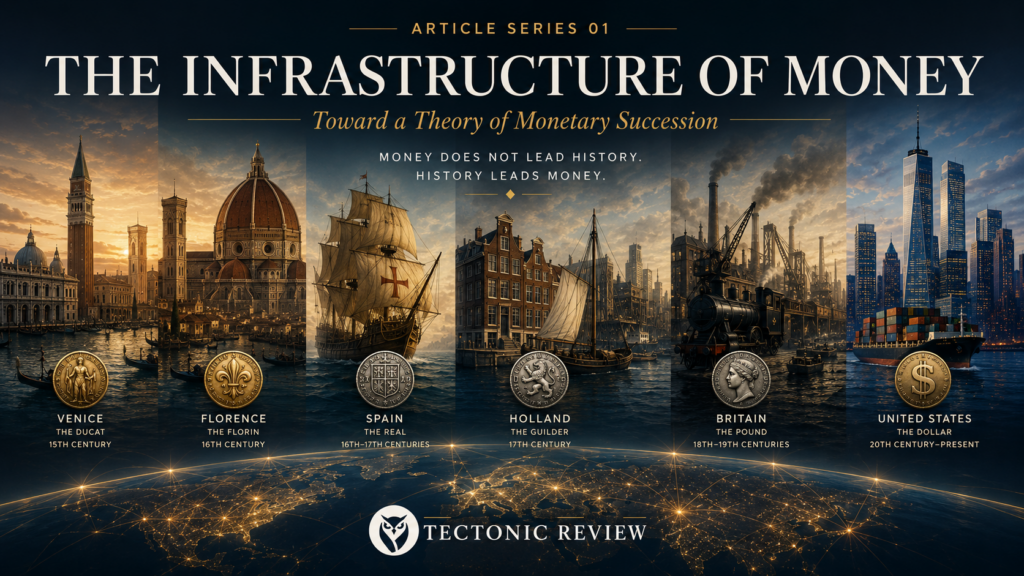
An essay on how monetary orders emerge from deeper shifts in productive architecture, systemic dependency and global indispensability.
Series
The Infrastructure of Money / A Theory of Monetary Succession / Part I / History Leads Money
Every generation believes the reserve currency of its time is permanent.
The merchants of Venice probably believed the ducat would dominate forever. The bankers of Florence likely assumed the florin would remain the foundation of European commerce. The Spanish Empire trusted its silver. The Dutch trusted their guilder. Britain trusted sterling.
Today, the world debates whether the US dollar can survive the rise of China, of Bitcoin, of stablecoins.
History suggests we may be asking the wrong question.
We often speak of reserve currencies as if they were monetary inventions — instruments designed by governments, engineered by central banks, or negotiated into existence by diplomats. They are not. They are historical outcomes. By the time a currency becomes global, the transformation that made it inevitable has usually been underway for decades. The money arrives last. The architecture that sustains it arrives first.
No historical pattern is deterministic. But recurring structures deserve attention. Across the major monetary transitions of the last six centuries, a consistent mechanism appears: every monetary order has been built upon the dominant productive architecture of its era — and when that architecture changes, the monetary system eventually changes with it.
By productive architecture I do not mean factories alone. I mean the entire system through which an economy creates indispensable value: resources, energy, production, logistics, finance, technology and institutions. The combination shifts across eras. But in every era, some version of it has existed — and around it, a monetary order has formed.
This essay does not attempt to predict which currency, if any, will eventually challenge the dollar. It proposes something more durable: a framework for reading how monetary dominance has shifted across six centuries — Venice to Florence, Florence to Spain, Spain to Holland, Holland to Britain, Britain to the United States — in the hope that the pattern, if it holds, remains useful whether the next transition takes ten years or fifty.
History leads money.
There is a view, popular in financial commentary, that treats money as pure narrative — a story that societies agree to believe, valuable only because enough people say it is. There is something true in this. A banknote is, in a narrow technical sense, a promise printed on paper. But no government decree has ever turned a weak economy into a reserve currency. And no reserve currency in history has survived the collapse of the productive system it was attached to.
The story is real. But behind every story, there has always been a material foundation holding it up.
Historians often treat reserve currencies as the origin of geopolitical power — as if the ducat made Venice rich, or the dollar made America strong. The relationship runs the other way.
Before Venice possessed Europe’s dominant currency, it already controlled the commercial arteries of the Mediterranean. Before Florence issued Europe’s preferred currency, it had already become the continent’s financial center. Before Spanish silver circulated across three continents, Spain already commanded an unprecedented flow of precious metals connecting Europe, the Americas and Asia. Before the guilder became the working currency of Baltic and Asian trade, the Dutch Republic had already built the world’s first modern stock exchange, its first central clearing bank, and the largest merchant fleet on Earth. Before sterling became the world’s reserve currency, Britain had already built the largest industrial economy, the most powerful navy and the most sophisticated commercial network on the planet.
The dollar followed the same pattern. The United States did not become powerful because the dollar went global. The dollar went global because the United States emerged from the Second World War as the industrial, financial and military center of the postwar order. Bretton Woods did not create that reality — it formalized one that already existed.
“Money does not create power. It records it.”
Here a distinction must be made — one implicit in the historical record but rarely stated directly, and essential to everything that follows.
The historical record examined in this essay suggests that the world’s largest economy is not necessarily the one whose currency becomes dominant. Across the major monetary transitions of the last six centuries, reserve currencies have belonged to economies that became indispensable to everyone else’s prosperity.
These are not the same thing.
An economy can be large without being indispensable — if it can be bypassed, replicated or ignored without catastrophic cost to the global economic order. An economy becomes truly indispensable when it controls what that order cannot function without: the trade routes, the financial architecture, the industrial capacity, the resources or the systemic infrastructure that holds the rest of the productive system together.
Size matters. But indispensability is what earns the currency.
This distinction dissolves many of the apparent puzzles in monetary history. Florence was never the largest economy in Europe. Holland was a small nation by any demographic measure. Neither size nor population determined the outcome. What determined it was the degree to which the surrounding global economic order had organized its own prosperity around what Florence or Holland uniquely provided — and the cost it would have borne trying to do without them.
“Size matters. But indispensability is what earns the currency.”
Timeline
Venice
Florence
Spain
Dutch Republic
Britain
United States
Each dominant currency in history was not simply attached to power. It was attached to a specific category of assets — what we might call foundational assets.
Definition
Foundational assets are the resources, capabilities and institutional systems whose control generates systemic dependency and which cannot be easily reproduced by others.
Not every valuable or strategic asset is foundational. Strategic assets create advantage. Foundational assets create dependence. Diamonds have always been scarce and valuable; they have never determined a monetary order. Timber was once essential to naval power; it did not generate reserve currencies. Coal powered the early stages of industrialization; its geopolitical significance has since receded. The distinction is not one of importance — it is one of irreplaceability at the systemic level.
Foundational assets are the resources, capabilities and institutional systems whose control generates systemic dependency and which cannot be easily reproduced by others. Two words carry the weight of that definition. The first is control — not possession. The second is reproduced — not merely replicated or substituted at cost. What transforms an asset into a foundational one is not its intrinsic value but its position within a controlled productive system that the rest of the global economic order finds itself structurally unable to do without.
Definition
Systemic dependency exists when an economy cannot sustain its own productive system without continuous access to another economy’s foundational assets.
Systemic dependency, in turn, has a precise meaning of its own: it exists when an economy cannot sustain its own productive system without continuous access to another economy’s foundational assets. This is not the ordinary dependency of trade or comparative advantage, where alternatives exist at some cost. It is a structural condition in which the removal of access threatens not efficiency but function.
History offers many examples of economies that possessed critical resources without ever achieving monetary dominance — because possession, without the organized system that others cannot reproduce, generates wealth but not dependency. What transforms resources into monetary power is not abundance. It is control organized into irreplaceable systems.
Every monetary order, across the transitions examined here, has rested upon the productive system the global economy could least function without.
What qualifies as a foundational asset changes from one era to the next — not because societies choose new priorities, but because technological revolutions periodically redefine what the global economic order requires in order to continue functioning. Each such revolution renders some previously indispensable assets less central and elevates new capabilities to foundational status for the first time.
And here a crucial observation: foundational assets are rarely abandoned. They are superseded. Maritime routes did not disappear when industrial capital became the binding constraint — they became less decisive. Industrial capacity did not vanish when the postwar security architecture reorganized the global order — it became assumed. Each transition restructures the hierarchy of indispensability without erasing what came before.
In the fifteenth century, the foundational asset was maritime connectivity: the capacity to link fragmented markets, settle debts across political borders, and keep the arteries of Mediterranean commerce open. Venice controlled it. The ducat traveled with the ships.
In the sixteenth century, as trade expanded across oceans, the foundational asset became metallic liquidity — standardized silver capable of settling transactions across continents that had never before been financially connected. Spain organized and controlled that system. The Real de a Ocho became the first truly global currency not because Madrid decreed it, but because it was the only instrument capable of performing that function at that scale.
In the seventeenth century, the foundational asset shifted to organizational scale and distributed risk. Individual merchants could no longer finance the voyages that the expanding global economy required. The Dutch solved it by building an institutional system — the joint-stock company, the Amsterdam Bourse, the Wisselbank — that others depended on but could not easily reproduce. The guilder was the monetary expression of that controlled architecture.
In the nineteenth century, the foundational asset was industrial capital — the financing of a transformation in manufacturing, shipping and global production that dwarfed anything that had come before. Britain controlled it. Sterling denominated the result.
In the twentieth century, the foundational assets were reconstruction capacity and security architecture — the ability to rebuild a shattered world economy and underwrite the stability without which global commerce could not resume. The United States controlled both. The dollar was the currency of that settlement.
These were not merely monetary transitions. They reflected changes in the organization of the global productive order itself: how societies produced, traded, financed, transported and ultimately survived. When the foundational assets shifted, the monetary order that rested upon them shifted too — not immediately, not cleanly, but consistently.
Six historical transitions. Six sets of foundational assets. Six different currencies. One recurring mechanism.
“Every monetary order has rested upon the productive system the global economy could least function without.”
Control of foundational assets does not directly produce a reserve currency.
Definition
Controlled Productive System is the organized system that the rest of the global economic order finds itself structurally unable to do without.
An economy that controls foundational assets organized into a system others cannot easily reproduce accumulates something more valuable than the assets themselves: it accumulates irreplaceability. Other economies find themselves in a condition of systemic dependency — unable to sustain their own productive capacity without continuous access to what the controlling economy provides.
Systemic dependency then drives something that no policy can manufacture: the concentration of financial activity. Because every economy dependent on the indispensable system must repeatedly buy, sell, invest, borrow and save within it, financial activity naturally gravitates toward the controlling economy. Liquidity is not created by decree. It emerges from repeated economic necessity — from the accumulated weight of transactions that the global order has no alternative but to route through the same center.
Definition
Deep Liquidity emerges from repeated economic necessity — from the accumulated weight of transactions that the global order has no alternative but to route through the same center.
Wherever the deepest, most liquid, most trusted markets exist, the currency of the controlling economy gradually becomes the preferred instrument of pricing, settlement and savings — reinforced at every step by the network effect, which makes a widely-used currency progressively more attractive to hold and harder to abandon.
Definition
Reserve Currency becomes the preferred instrument of pricing, settlement and savings where the deepest, most liquid, most trusted markets exist.
The chain, then, is this:
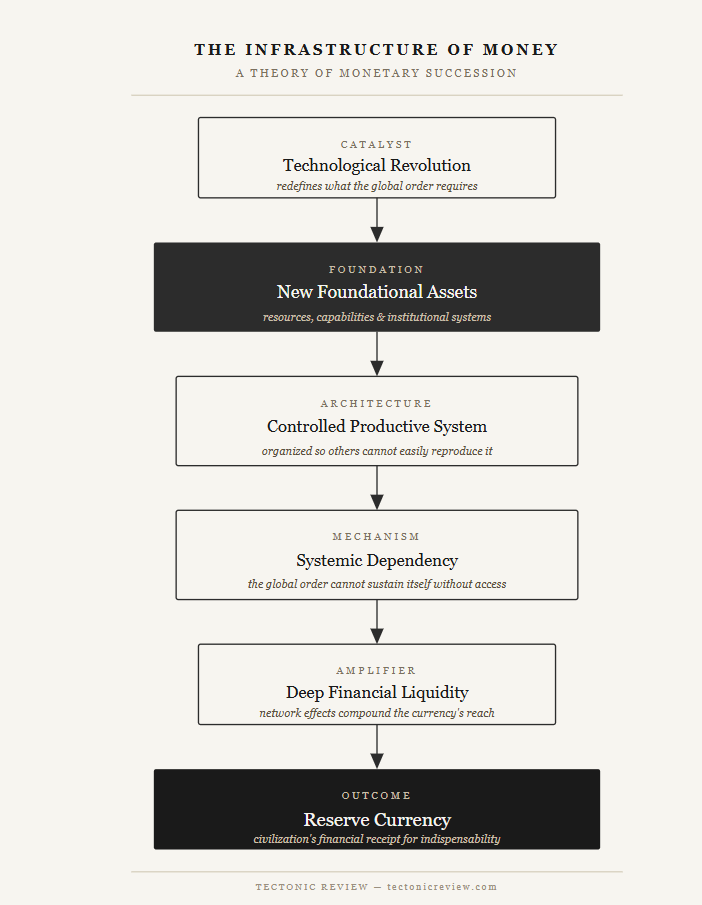
Each link is necessary. None is sufficient alone. And the chain has begun, in the transitions examined here, not in the treasury or the central bank, but in the productive system the global economy found it most costly to do without.
There is a corollary to this logic that deserves equal weight: reserve currencies do not disappear when they fail. They disappear when dependence on the productive system they represent gradually erodes. The florin did not collapse because Florence made monetary mistakes. It faded because the problem it solved — the organization of continental credit — was gradually subsumed into larger and more complex systems that Florence no longer uniquely controlled.
“The same logic applies to each currency that has lost reserve status across the transitions examined here. And it applies, in principle, to any currency that holds it today.”
This inversion is worth sitting with — and it is not a new idea.
Historians of the longue durée, from Fernand Braudel’s study of Mediterranean capitalism to Paul Kennedy’s analysis of great power succession, have long observed that financial dominance follows productive dominance, rarely the other way around. Charles Kindleberger argued that international stability requires a single power willing to underwrite the system — including its money. Susan Strange described monetary dominance as one dimension of structural power: the capacity to shape the framework within which everyone else must produce, trade and borrow.
What the present essay adds to that tradition is a specific claim — one that might be called the Foundational Asset Theory of Monetary Succession: that the unit of analysis beneath hegemony, beneath structural power, beneath the longue durée, is the foundational asset, organized into a controlled productive system that generates systemic dependency and cannot easily be reproduced. The economy that occupies that position does not merely accumulate power in the general sense. It accumulates the specific kind of power that eventually gets monetized.
A reserve currency is not a reward. It is an accounting record — civilization’s financial receipt for indispensability.
“A reserve currency is not a reward. It is an accounting record — civilization’s financial receipt for indispensability.”
“Across the transitions examined here, every reserve currency has been backed by the productive system the global economy could least function without — not always by law, but always by economic necessity.”
This formulation matters. It avoids the imprecision of saying that the florin was “backed by banking” or that the dollar was “backed by oil.” Neither claim is accurate in the technical sense. What is accurate is that each currency derived its credibility from the fact that the productive system it represented was one the global order could not afford to lose. Holding the currency was, in effect, holding a stake in the continuity of that system.
There is a second mechanism worth naming — one that only becomes visible once a currency has achieved dominance, and that illuminates why the crown, despite its privileges, is not without cost.
The economist Robert Triffin identified it in 1960. To be the world’s banker, he observed, an economy must supply its currency to the world — which means running permanent trade deficits, exporting more money than it takes in through commerce. The reserve issuer is the only economy expected, even required, to do this. It is the rent paid to hold the crown. America has paid it for eighty years. The trade deficits that generate political controversy at every election cycle are not, in this reading, a sign of weakness in the ordinary sense. They are the structural consequence of being the economy everyone else chooses to run through.
Triffin described one of the consequences of monetary dominance. This essay asks a different question: what creates monetary dominance in the first place?
“Only an economy with sufficient productive and institutional depth can absorb the structural deficits the role requires over time.”
The Dilemma nonetheless illuminates something essential. It explains why monetary dominance is not merely attractive — it is also, paradoxically, demanding. The crown does not merely go to the strongest. It goes to the economy indispensable enough that others find it less costly to continue the arrangement than to seek an alternative.
A sharp reader will object at this point.
Bretton Woods was a negotiated treaty, signed by delegates in a New Hampshire hotel in 1944. The petrodollar arrangement with Saudi Arabia in the early 1970s was a deliberate bilateral bargain, not a spontaneous consequence of foundational assets. Surely these were political choices — moments when power and money were constructed together, by design?
They were choices. But choices made on top of material foundations that already existed.
In 1944, the United States held roughly two-thirds of the world’s gold reserves and stood as the only major industrial economy to emerge from the war intact. Bretton Woods negotiated the terms of that dominance — it did not manufacture the dominance itself. No delegation at the table could have voted Britain or France into that position; the underlying productive order had already decided it.
The petrodollar arrangement tells the same story from a different angle. Washington could offer Riyadh security guarantees and access to the deepest capital market on Earth precisely because that capital market, and the military reach behind it, already existed. The agreement extended a dominance under strain — the dollar had just been cut loose from gold in 1971 — but it could not have invented that dominance from nothing.
Negotiated monetary arrangements are not exceptions to the pattern. They are foundational-asset power exercising its remaining leverage to extend its own lifespan — and they tend to arrive precisely when the productive transformation that will eventually displace the old order has already begun.
Across the six transitions examined in this essay, the sequence has been consistent enough to suggest something structural rather than accidental.
First comes a transformation in the productive order — a new set of foundational assets becomes indispensable to the functioning of the global economy, and one economy moves to organize and control them into a system that others cannot easily reproduce. Systemic dependency follows. Financial adaptation comes next: banks reorganize, capital markets deepen, trade gradually resettles in a new unit of account. A reserve currency does not emerge by proclamation. It consolidates — the last expression of a process that began not in the treasury or the central bank, but in the controlled productive architecture of the economy that came to hold what the global order could least do without.
Across these transitions, each one had something that made it legible in advance: a successor already accumulating the foundational assets that the next era would depend upon, already building the controlled system that would eventually generate dependency. Across the transitions examined here, the crown did not leap to strangers. It passed to whoever already controlled what the global economic order could least afford to lose.
If the mechanism described in this essay continues to hold, the debate around the dollar has been framed around the wrong question. The question is not which currency comes next. It is which foundational assets are becoming indispensable now — who controls them, and who is building the productive system that others will find impossible to reproduce.
Series Navigation