Physical Address
304 North Cardinal St.
Dorchester Center, MA 02124
Physical Address
304 North Cardinal St.
Dorchester Center, MA 02124
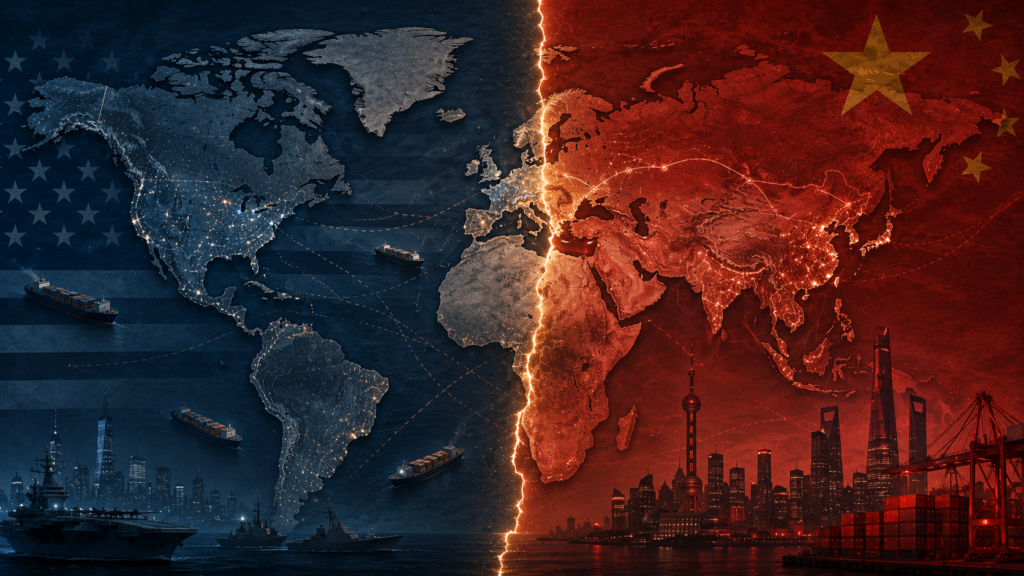
On May 14, 2026, Chinese President Xi Jinping opened his summit with Donald Trump in Beijing with a single question: could the United States and China overcome the “Thucydides Trap” and build a new paradigm for great power relations? The question sounded philosophical. It was not. It was a negotiating proposal — and the most consequential one of the century. This essay argues that we are witnessing the deliberate construction of a new global order. Not the multipolar world that most analysts predict. Something older, simpler, and far more consequential: a bipolar division of the planet between two powers that have concluded they need each other more than they fear each other — and that the greatest threat to both is not their rivalry, but the emergence of a third pole capable of making them both irrelevant.
The concept Xi invoked in Beijing was coined by Harvard political scientist Graham Allison: the “Thucydides Trap” describes the tendency of established powers to go to war when challenged by rising ones. Allison identified sixteen cases in history where this dynamic played out. Twelve ended in war. Xi has raised the concept repeatedly — in 2015 in Seattle, in 2023 with Senate Majority Leader Schumer, in 2024 with Biden in Lima, and now with Trump in Beijing. Each time, his message has been the same: “Planet Earth is vast enough to accommodate the respective development and common prosperity of China and the United States.” Read diplomatically, this sounds like a call for peaceful coexistence. Read strategically, it is something more precise: a proposal that the two dominant powers agree to divide the world rather than destroy it — and that they do so before a third actor makes the negotiation unnecessary. The historical parallel Xi did not invoke, but which illuminates his logic precisely, is Tordesillas. In 1494, Portugal and Spain — the two superpowers of their age — faced a problem. The age of exploration had opened the entire non-European world to conquest and exploitation. Both powers had the capability to claim everything. War between them would exhaust both and achieve nothing. The solution was elegant: the Treaty of Tordesillas drew a line down the Atlantic, dividing the world in two. Portugal took the east; Spain took the west. The arrangement held for decades. The power that Tordesillas effectively excluded was England. At the time, England was a secondary European power — significant but not yet dominant. Within a century, it had become the world’s foremost maritime and commercial empire, precisely because it refused to accept the terms set by others and found the spaces the treaty had overlooked.
To understand why Washington and Beijing might prefer a bipolar world, you need to understand what the alternative looks like from their respective positions. A Europe that achieves energy independence — through its geological hydrogen potential in France, Portugal, and the Atlantic margin — and that reconstructs its relationship with Russia on the basis of complementary resources rather than inherited antagonism, would be the most formidable economic bloc in modern history. Consider the arithmetic: European technological and industrial capital, combined with Russian mineral endowment, agricultural capacity, and strategic depth, spanning a continuous landmass from Lisbon to Vladivostok. Energy-independent, thanks to the geological hydrogen corridor of the Western Atlantic. Monetarily autonomous, capable of pricing its own resources in its own currencies. Industrially complete in ways that neither the United States nor China currently is. In June 2025, the French government officially confirmed natural hydrogen reserves in Lorraine of approximately 46 million tons — roughly half of current global annual hydrogen production — alongside significant confirmed reserves in the Pyrenees and Aquitaine, with purity levels exceeding 90% at some sites. Portugal’s extended continental shelf claim, if validated, would give it the tenth largest maritime boundary in the world, encompassing stretches of the Mid-Atlantic Ridge where serpentinization-driven hydrogen generation is among the most geologically active on the planet. Cuba’s ophiolite structures place it among the most significant candidate hydrogen provinces in the hemisphere. The geological hydrogen corridor of the Western Atlantic is not speculative. It is documented. A Europe that controls or is allied with this corridor, reconciled with Russia’s complementary resource endowment, does not need American LNG, does not need Chinese manufacturing dominance, and does not need either power’s permission to price its own energy in its own currency. This is the scenario that both Washington and Beijing have the strongest possible structural interest in preventing. For Washington, a self-sufficient Europe breaks the Atlantic system that has sustained dollar hegemony since 1945 — removing the largest block of dollar-denominated trade and Treasury-bond-holding sovereign wealth from the American financial architecture. For Beijing, an autonomous Europe provides a third market, a third technology base, and a third monetary system that would erode Chinese manufacturing dominance by offering an alternative supply chain beyond American reach — and beyond Chinese control.
Understanding that the strategic objective is to prevent European autonomy allows every apparently disconnected conflict to be read as part of a single architecture. Ukraine is the most visible instrument. A Europe consumed by the costs of a prolonged continental war — spending on rearmament, divided over strategy, psychologically exhausted — cannot simultaneously pursue strategic autonomy. More concretely: the energy dependence that Russia’s gas created was a vulnerability, but it was also the infrastructure of a relationship. Severing it, and replacing Russian gas with American LNG through long-term contracts, does not merely solve a supply problem. It reconfigures Europe’s energy dependency from East to West — from a relationship that pointed toward eventual Eurasian integration to one that points toward permanent Atlantic subordination. The ceasefire that has not materialized, the negotiations that have stalled, the military support calibrated to sustain but not resolve — these are not failures of diplomacy. They are the intended condition. A frozen conflict keeps Russia isolated, Europe dependent, and the possibility of reconciliation permanently deferred. Note what happened simultaneously at the Trump-Xi summit in Beijing: Trump said he did not expect Chinese help in the Iran war. Xi offered to help reopen the Strait of Hormuz. The two powers coordinated, implicitly, on a Middle Eastern conflict that neither needed to resolve urgently, while exchanging signals about their respective spheres. Iran illuminates a different dimension. The US-Israeli strikes that began on February 28, 2026 — targeting Iranian military infrastructure and resulting in the death of Supreme Leader Khamenei — were immediately framed as a response to nuclear and ballistic missile programs. The framing is real but incomplete. The Strait of Hormuz carries approximately 20% of global petroleum and 20% of global LNG annually. Its closure, which Iran enacted in response to the strikes, created an immediate global fuel crisis — spiking oil and gas prices in ways that benefited Russia and, temporarily, Iran itself, while putting severe strain on Asian economies dependent on Gulf energy, China prominently among them. The pressure on China was not incidental. Control over the chokepoint through which a fifth of the world’s energy flows is leverage over every power whose industrial economy depends on it — which is to say, every power. There is a second dimension. Iran’s mineral geography — its position at the intersection of routes that connect Central Asian and Persian Gulf resource flows toward both European and Asian markets — makes the country a structural prize in the contest over critical mineral supply chains. An Iran under new management, or at minimum an Iran whose mineral export routes pass through American-supervised channels, alters the supply chain calculus for Chinese battery manufacturing and rare earth processing in ways that no tariff could achieve. There is a third dimension that almost no commentary has registered. The consensus narrative about the AI race focuses on semiconductors; the structural reality focuses on megawatts. Advanced computation and the massive data center clusters required to sustain sovereign AI models are pushing global power grids to their absolute limits. AI is not merely a software race — it is an infrastructure race that demands cheap, constant, and abundant baseload power. Prior to the 2026 escalations, the Gulf monarchies — immediate neighbors of Iran — were aggressively positioning themselves as the data center hubs of the future, leveraging sovereign wealth to build massive, energy-backed computing architectures. The US-Israeli strikes, and the subsequent activation of regional proxies, transformed the entire Middle East into an active conflict zone. In doing so, they effectively paralyzed the multi-billion-dollar computing ambitions of Washington’s nominal Gulf allies — neutralizing the Persian Gulf as a potential competitor in the infrastructure of the cognitive transition at the precise moment that competition was becoming consequential.
China won the electric vehicle transition. Not partially — decisively. Its battery technology, manufacturing scale, supply chain integration from raw material to finished product, and domestic market depth give it advantages that Western competitors cannot close on the current trajectory. China controls approximately 70% of global rare earth mining and more than 90% of downstream processing — the refining and magnet production that no tariff wall can rapidly replicate. Since December 2024, China has banned exports of germanium, gallium, and antimony to the United States — three minerals critical to defense applications. In the spring of 2025, Ford was temporarily forced to pause Explorer production over a rare earth magnet shortage. The industrial dependency is not theoretical. It is already operational. A strategist facing this situation has two options. The first is to compete on China’s terms. The second is to change the game entirely. Streaming did not beat Blu-ray by offering a better disc. It made the disc irrelevant. Geological hydrogen — produced not by industrial processes but by the Earth’s own geochemistry, continuously, at scales that dwarf any manufacturing capacity — is the streaming equivalent. It cannot be controlled through rare earth processing monopolies. Its geography follows plate tectonics, not industrial policy. And the Western Atlantic and Western Hemisphere hold an extraordinary concentration of the formations most associated with its generation. But the hydrogen infrastructure does not yet exist at scale. The science is ahead of the engineering, the engineering ahead of the financial architecture. The transition needs time — and the most effective way to buy that time is to keep oil cheap enough that the urgency of the electric transition remains manageable. The engineering challenge is formidable. Because hydrogen possesses low volumetric energy density and induces molecular embrittlement in standard metallic pipelines, the race is not merely about tapping geological deposits. It is a race to control the technological standards for molecular transport — specifically through advanced Liquid Organic Hydrogen Carriers and green ammonia synthesis. The cheap oil strategy buys the critical window required to establish these global midstream standards before non-American competitors can lock in alternative networks. Venezuela enters here with precision. Under intense American pressure, Venezuela’s oil sector was opened to private foreign investment in early 2025, ending PDVSA’s monopoly. Combined with ExxonMobil’s Guyana operations — now producing 645,000 barrels per day with projections above 1.2 million by 2027, secured against Venezuelan territorial claims by the removal of Maduro — the Western Hemisphere oil supply is positioned to sustain price pressure on global markets for decades.
In November 2025, the Trump administration’s National Security Strategy made the architecture explicit: “After years of neglect, the United States will reassert and enforce the Monroe Doctrine to restore American preeminence in the Western Hemisphere. We will deny non-Hemispheric competitors the ability to position forces or other threatening capabilities, or to own or control strategically vital assets, in our Hemisphere.” Read as a diplomatic posture, this is familiar American unilateralism. Read as an energy strategy, it is a territorial claim on the geological hydrogen provinces of the Western Atlantic — and an exclusion order directed at every non-American power that might otherwise position itself to develop them. Cuba’s ophiolite-bearing geological structures, confirmed at depth by offshore drilling, place it among the most significant candidate hydrogen provinces in the hemisphere. Cuba sits 145 kilometres from Florida. The American embargo, maintained through every geopolitical transformation of the past sixty years despite surviving no ideological rationale that has not already been abandoned elsewhere, makes sense as a holding position — a mechanism for preventing non-American capital from establishing terms of development before Washington is ready to set them itself. When the United States eventually normalizes relations with Cuba, the timing will not be driven by human rights or diplomacy. It will be driven by the moment when American capital and American regulatory frameworks are ready to define the terms of Cuba’s entry into the hydrogen economy. China had invested approximately 67 billion dollars in Venezuela, with roughly 90% of Venezuelan oil exports flowing to China by late 2025. A Chinese company signed a one-billion-dollar, twenty-year agreement to develop Venezuelan oil fields in August 2025. Three months later, the US intervention removed Maduro. The investment was stranded. The message to non-hemispheric competitors was unambiguous.
Against this backdrop, the Trump-Xi summit of May 14-15, 2026 reads differently from the trade negotiation it was presented as. Trump came home from Beijing with trade deals and what he described as a Chinese offer to help reopen the Strait of Hormuz. Xi opened the meeting by asking whether the two countries could together escape the Thucydides Trap. The official readouts described agreements on agriculture, investment frameworks, and “constructive strategic stability” — a phrase China’s leadership felt particularly positive about, according to Brookings Institution analysis published the following week. Neither side discussed Europe’s strategic interests. Neither side was asked to. The Thucydides Trap framing is, in this context, Xi’s version of the Tordesillas proposal. The historical parallel is precise. In 1494, Portugal and Spain were not friends — they were rivals who understood that their rivalry, unconstrained, would exhaust both. The treaty was not about trust. It was about the mutual recognition that division was more profitable than destruction. Xi’s message to Trump is structurally identical: “The planet is large enough for both of us. We do not need to fight over the same spaces. You take your hemisphere; we develop ours. We will not challenge your Atlantic energy geography; you will not challenge our Pacific and Eurasian positioning. We will trade, we will coordinate on chokepoints like Hormuz, and we will both be richer and more secure than if we spend the next century in conflict.” What this arrangement excludes, as Tordesillas excluded England, is the third pole. A Europe that might have mediated, balanced, or simply provided an alternative to the G2 condominium is rendered structurally dependent — on American energy through the LNG contracts signed during the Ukraine war, on Chinese manufacturing through supply chains too deep to rapidly replace, and on neither power’s goodwill when its own strategic interests conflict with the bilateral arrangement.
Every thread of this analysis converges on a single objective. The petrodollar system — established when Saudi Arabia agreed in 1974 to price oil in US dollars in exchange for American military support — sustained dollar reserve status for fifty years. It worked because oil was the world’s primary energy currency, traded globally in dollars, with surpluses recycled into US Treasury bonds. On June 9, 2024, Saudi Arabia allowed the agreement to expire without renewal, joining BRICS, signing yuan-denominated oil agreements, and entering the mBridge platform for dollar-independent trade settlement. This was not the end of dollar dominance. It was the signal that its current foundation — oil denomination — is structurally eroding, and that the next energy system will determine which currency inherits the reserve function. Monetary hegemony does not require oil specifically. It requires that the world’s primary energy source be priced and traded in the hegemon’s currency. If hydrogen becomes the primary energy source of the twenty-first century, and if the dominant hydrogen producers price and trade in dollars, dollar hegemony survives the transition from fossil fuels. If hydrogen is priced in yuan, euros, or a BRICS basket currency, it does not. The United States is positioning itself to be the dominant producer of geological hydrogen in the Western hemisphere. It is securing that position through the Monroe Doctrine’s explicit revival, through control of Cuba’s geological future, through Guyana’s oil revenues that fund the long transition, and through the Atlantic energy corridor it shares with Portugal and France — both NATO allies whose hydrogen potential falls naturally within the dollar-denominated development framework.
The Chess Reading A grandmaster studying this board would note that the most consequential moves are those that accomplish multiple objectives simultaneously. Ukraine is not a single war but a multi-layered instrument: separating Russia from Europe, redirecting Europe’s energy dependence westward, foreclosing a euro-Siberian alignment, and reinforcing NATO’s structural centrality — all at once. Iran serves a parallel function: controlling Hormuz, pressuring Chinese mineral supply routes, removing an independent regional energy power, neutralizing the Gulf as a future AI infrastructure competitor, and signaling to Beijing that Washington sets the terms of the Middle Eastern board. Venezuela and Guyana together reopen low-cost hemisphere oil, remove Chinese investment from the region, secure Exxon’s most productive asset, and demonstrate that the Monroe Doctrine is operational rather than rhetorical. Cuba’s isolation preserves a strategic option — control over a potentially decisive hydrogen province at the geographic center of the Western Atlantic corridor — at minimal ongoing cost. The Beijing summit signals mutual recognition of spheres, coordinates on Hormuz, exchanges assurances on Taiwan and rare earths, and implicitly excludes Europe from the negotiation. One meeting; the architecture of the next fifty years under construction. What appears as chaos — sanctions, interventions, tariff wars, proxy conflicts — may instead reflect a coherent strategy operating across several theaters at once. The failure is not in the strategy. It is in the analysis that treats each event as discrete. This does not make such a strategy admirable. It makes it legible. Historical precedents suggest that lines drawn by dominant powers endure only until the excluded find the means to contest them. When Queen Elizabeth I confronted the rigid partition of Tordesillas, she declared that “the use of the sea and air is common to all” — and proceeded to fund a privateer infrastructure designed to exploit exactly the spaces the treaty had overlooked. England did not petition for inclusion. It built its own fleet. The line drawn in Beijing is not the end of history. It is the opening move of a new contest — and the essays that follow in Tectonic Review will map the terrain of that contest in detail. Every other power on the board — Europe above all, but also the resource-rich nations of the Global South, every state that assumed the coming world would be multipolar — now faces the same question England faced in 1494: Do you accept the terms of someone else’s Tordesillas?
This essay is the founding text of Tectonic Review’s analytical series on the structural forces reshaping the global order. Each theme introduced here — the geological hydrogen geography of the Americas and the Atlantic, the rare earth contest and its military dimensions, the monetary architecture of the energy transition, the European strategic dilemma, the position of the Global South, the Iran conflict and its supply chain and AI infrastructure dimensions, the future of the dollar — will be examined in depth in subsequent essays. Tectonic Review is an independent publication. We have no institutional affiliations and no commercial relationships that constrain our conclusions. We write for readers who want to understand the board — not just the pieces.