Physical Address
304 North Cardinal St.
Dorchester Center, MA 02124
Physical Address
304 North Cardinal St.
Dorchester Center, MA 02124

Essay
AI, Demography and the New Sovereign Bargain
What if the most important economic role of human beings in the twenty-first century is no longer to produce, but to consume?

An essay on automation, demographic decline and the changing foundations of economic power.
For more than two centuries, economic power has tracked population almost as a matter of course. Larger populations meant larger armies, larger workforces, larger domestic markets, greater productive capacity — which is why nations spent so much of the modern era competing for territory, for resources, and above all for people themselves, one of the most valuable economic assets a country could hold.
That assumption built the world we still live in. Immigration turned into an economic necessity. Birth rates became matters of state. Developing nations built entire growth models on cheap, abundant labor, while wealthier economies leaned on a steady inflow of workers just to keep expanding and to support populations that were quietly getting older.
Now a deeper shift may be underway, one that cuts against an assumption the industrial age never had to question. Artificial intelligence and advanced robotics aren’t simply making production more efficient. They may be rewriting the relationship between population, output and power itself — to the point that, for the first time since the Industrial Revolution, an economy could plausibly keep growing even as its working-age population shrinks.
The consequences reach well past economics. They may go a long way toward explaining why automation, anti-immigration politics, and a fresh scramble for strategic resources are all rising at once.
Key Thesis
The central challenge of industrial economies was expanding production. The central challenge of automated economies may become sustaining consumption.
“The industrial state went looking for workers. The automated state may go looking for consumers instead.”
Key Insight
Aging societies cannot rely indefinitely on workforce expansion to sustain economic growth.
The modern economy was built on a simple reality: human labor was scarce, and almost everything depended on having enough of it. Factories needed workers, farms needed workers, warehouses needed workers, and so did transportation — even the most knowledge-intensive industries leaned on large pools of educated professionals. So nations faced a problem that never really went away: growth meant a growing labor force, and when birth rates fell, immigration was the obvious fix. That logic ran through economic thinking across most of the developed world for generations.
Artificial intelligence and robotics attack that assumption directly. A warehouse that once needed a thousand employees may soon run on a fraction of that number. Autonomous vehicles threaten the demand for drivers. AI systems are taking on administrative, analytical and even creative work that used to require whole teams of professionals.
The interesting question, then, isn’t whether automation will replace certain jobs — that’s already happening. It’s whether labor itself stops being the main constraint on how much an economy can produce. If it does, nations may end up far less tied to population growth and immigration than at any point in modern history.
Key Insight
Artificial intelligence increases productivity while reducing dependence on human labor.
“It’s whether labor itself stops being the main constraint on how much an economy can produce.”
Key Insight
If automation reduces labor as the main constraint, demand may become the binding constraint instead.
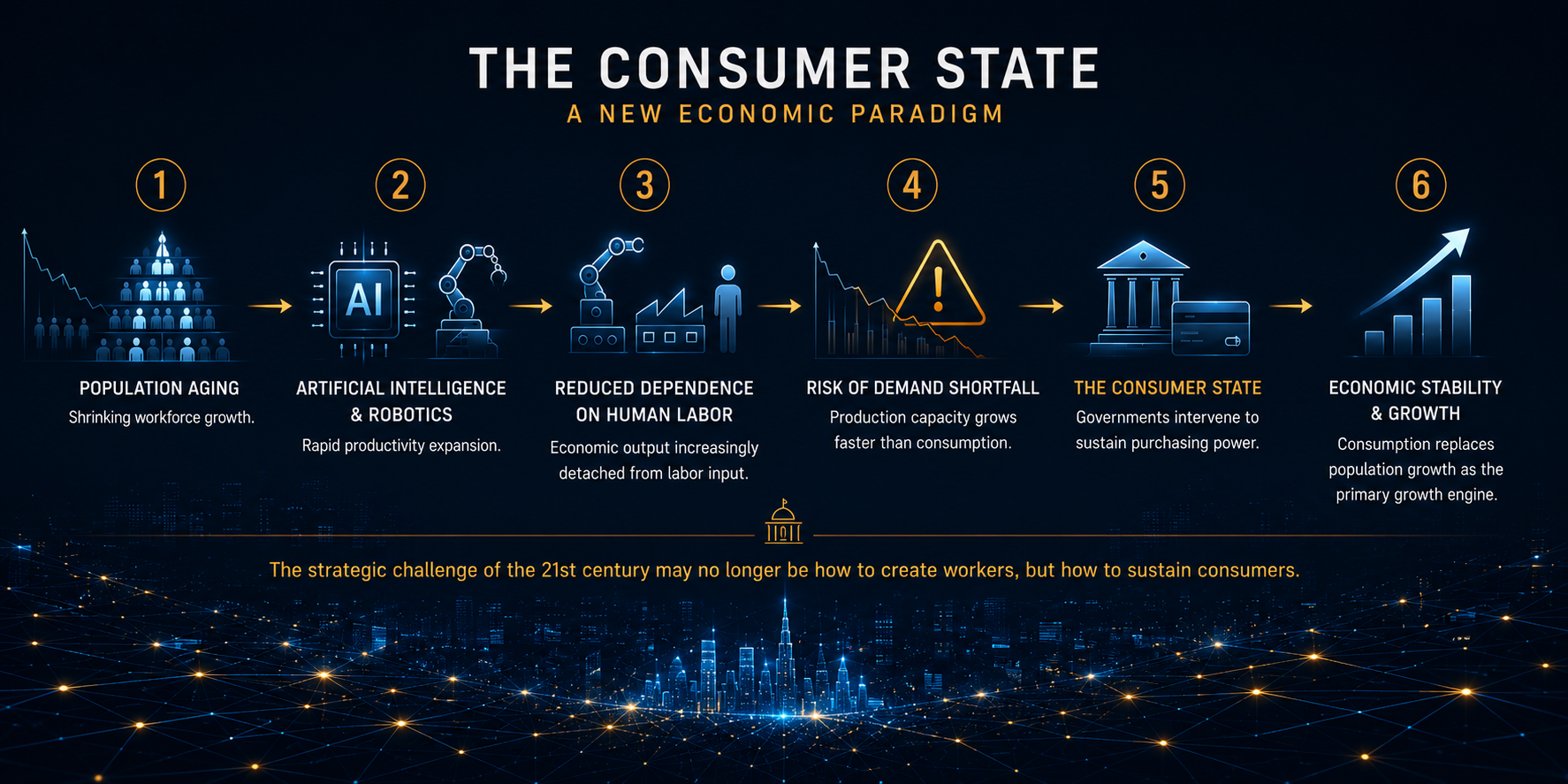
Figure 1 — The Consumer State Framework
A conceptual map of how demographic decline, artificial intelligence, automation and state intervention may shift economic gravity from labor supply toward consumer demand.
Key Insight
Consumption increasingly becomes the limiting factor of economic expansion.
Much of the current debate treats anti-immigration politics as a cultural phenomenon, full stop. Culture clearly matters — but economics may be doing more of the work here than most observers give it credit for.
For decades, restricting immigration carried a real economic cost, because economies needed the extra workers. That created an odd tension: a society could oppose immigration at the ballot box while still depending on it to keep the lights on. Automation changes that math. As the economic case for imported labor fades, political resistance to immigration gets a lot easier to sustain.
None of this means technology causes nationalism. It’s more that automation quietly removes one of the strongest arguments against it — which could open the door to a political environment where borders close more easily, simply because machines are taking over the economic role migrant labor used to play.
There’s a deeper distinction at work between the migrant worker and the machine — one that might explain why automation draws so much less resentment than immigration, even when both are doing the exact same job of replacing labor.
An immigrant is productive, yes, but an immigrant is also a claimant. He or she needs wages, housing, healthcare, schooling, and eventually a political voice — and some of what’s earned may flow back home rather than getting spent locally. To a resentful native population, that makes the immigrant look like a rival for a limited pool of wages, services and belonging.
A machine claims nothing. It doesn’t need a paycheck, a house, a school, or a vote — it produces without drawing on any of the social goods a human worker would require. So whatever resentment automation does stir up tends to attach itself to unemployment as an abstraction, not to a visible rival competing for scarce resources.
That may be the real reason automation is so much easier to swallow, politically, than immigration, even though the two do the same economic work: the machine removes a claimant from the equation without removing the output.
“A machine claims nothing.”
But there’s a catch hiding inside that apparent advantage. A machine making no claim doesn’t mean no claim exists — it means the claim has simply moved. Someone owns the machine, and ownership is itself a claim on whatever value that machine produces. Concentrate the ownership of productive capital narrowly enough, and the wealth automation generates never really disperses through society; it just piles up quietly with whoever holds the machines, the algorithms, and the platforms running them.
Which means the political calm bought by swapping migrant labor for automated labor could be temporary rather than permanent. It depends on one gap staying invisible — between a machine that claims nothing and an owner whose claim is simply harder to see than a paycheck. The moment that gap becomes obvious, through widening inequality, swollen corporate profits, or a labor share of income that never recovers, the resentment once aimed at immigrants may find a new target. Not the robot — it has no face and no vote — but whoever owns it, who has both.
A politics built around resisting one kind of labor substitution may, eventually, resist another. The first migration it fought was of people. The second might be of capital.
Key Insight
Automation may feel politically easier than immigration because it removes labor without introducing a visible social claimant — but it does not remove ownership claims.
This tension may already be working itself out in practice. Lawmakers and AI executives across the political spectrum have, in recent years, landed on strikingly similar answers without much coordination: some version of a sovereign fund, built on a claim to the equity or profits of automated industry, paying dividends straight to citizens. The proposals vary enormously in scale and method, but they share one premise — that the state, not the labor market, becomes the pipe through which the wealth machines create finally reaches ordinary people.
That would be a real break from the model that ran the last two centuries, where wages were what connected production to consumption and the state’s redistributive role stayed secondary — correcting the market’s outcomes rather than replacing them. A government that holds, or taxes, the equity behind automated production starts to look less like twentieth-century industrial capitalism and more like the resource-rent economies of oil states, where a sovereign fund captures wealth the population never earned through labor and hands it back as a citizenship dividend instead of a paycheck.
Whether this model takes hold, gives way to capital ownership spread much more broadly, or simply fails to materialize — leaving automation’s gains stuck with a narrow class of owners — may turn out to be the defining political-economic question of the coming decades. At bottom, it’s a fight over who inherits a claim the machine itself never made.
Key Insight
The state may re-emerge as the central distributor of automated wealth if wages no longer connect production to mass consumption.
If capital ownership decides who actually captures the wealth machines create, then how that capital — along with the resources and technology behind it — gets distributed globally becomes a central question of geopolitical power.
Plenty of analysts assume the future will simply split between technological powers and everyone else. Reality looks messier than that. Three strategic assets seem to matter increasingly:
Technology sets what a country can produce. Resources set the physical limits it has to work within. Consumers set how much demand exists to absorb it all.
Put those three together and the world sorts into four rough camps.
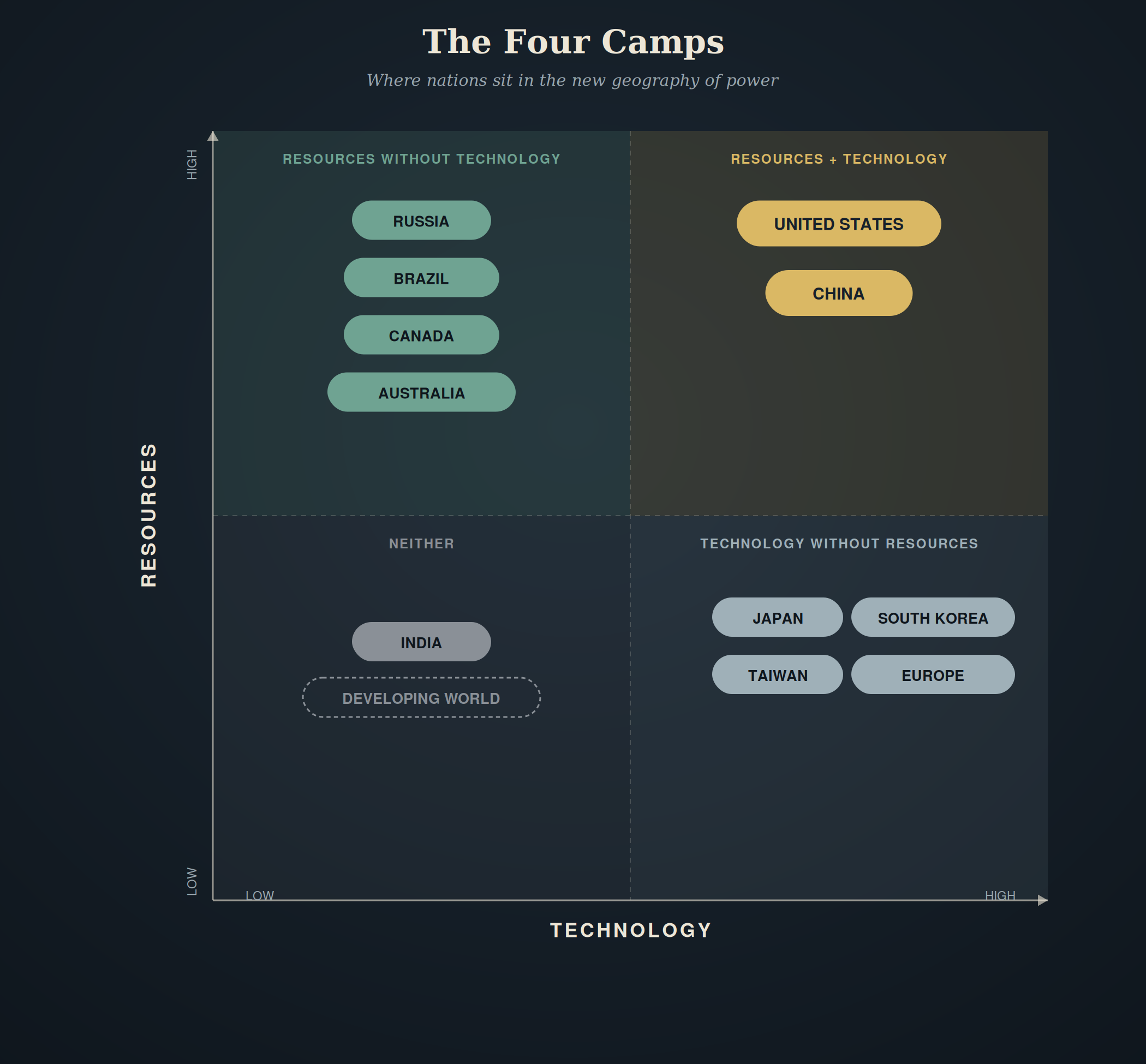
A strategic map of where nations sit on the axes of technology and resources.
The first combines resources and technology — the position the United States and China both occupy, even though they’ve built their way there through very different internal architectures. The American model has long run on consumption financed by credit, deep capital markets and the dollar’s reserve status, with wealth effects standing in for wage growth. China’s model historically prioritized production, investment and exports over domestic demand, and its current push to grow a larger consumer class is a deliberate — and still unproven — pivot away from decades of investment-led growth.
The second camp has technology but no secure resource base. Japan, South Korea, Taiwan and much of industrial Europe fit here: deep manufacturing and technological sophistication, paired with heavy reliance on imported energy and minerals. It’s a powerful position, but a conditional one, vulnerable to whatever disrupts the supply chains holding it up.
The third camp has resources but lacks cutting-edge technology, and Russia is the textbook case. Its industry has struggled to build competitive advanced semiconductors or frontier AI, and Western sanctions have only deepened that isolation. And yet Russia sits on some of the world’s largest reserves of nickel, palladium and rare earth elements, and has been racing to build up domestic lithium production — precisely the minerals an increasingly automated global economy needs more of, not less. Russian officials have, in recent years, presented those reserves at international forums as a strategic asset open to partners including China, India and Saudi Arabia. There’s a real irony here: a country living through one of the steepest demographic declines on earth may be growing more relevant rather than less — not because of its people, but because of what’s underneath them. Getting back to relevance, though, runs through partnership rather than self-sufficiency, most plausibly with China, which already supplies much of the technology Russia needs to develop and process its own resources.
Russia isn’t alone in this camp, either. Resource powers like Brazil, Canada and Australia may end up in a stronger strategic position than conventional measures of technological development would lead you to expect.
The fourth camp has neither, and much of the developing world has spent decades assuming population alone was a path to future economic weight — a demographic dividend that would eventually turn a young, growing workforce into rising consumption and global clout. India is the most consequential test case for that assumption. Its government still frames its huge youth population as a structural advantage in the AI era. But the same technology is now eating into the specific economic base that powered India’s growth for two decades: a large, relatively cheap, English-speaking workforce in IT and business-process outsourcing. As generative AI shrinks hiring in that sector, the aspirational middle class it built — people buying homes, financing their kids’ education, driving consumption — comes under real pressure, even as nearly half of India’s workforce stays stuck in agriculture, which generates only a sliver of the country’s output. India’s economy can keep growing in absolute terms simply because of its sheer size. Whether its people get richer relative to the technological and resource powers above them is an entirely separate question — and one the demographic-dividend thesis, on its own, no longer answers.
A world that values labor less is bound to value population, in the old sense, differently. Scale without resources or technology doesn’t buy the seat at the table it used to.
The new map also cuts across institutions built for an older one. BRICS groups China, Russia, India and Brazil under a single banner of solidarity, yet on this axis the four sit in three entirely different camps. The G7 ties the United States to Japan and much of industrial Europe, even though one occupies the top tier and the others sit a level below it on resources alone. Security alliances and historical loyalty may well keep these blocs intact on paper. Whether they hold together on the deeper axis of technology and resources is a separate question, and a far less settled one.
None of this guarantees Brazil, Canada and Australia stay above the fray, either. Russia made its choice and leans toward China for the technology its resources need. The other three haven’t had to choose yet — but if Washington and Beijing start treating access to critical minerals and farmland as a contest rather than a market, that may not last much longer. A handful of resource-rich middle powers, courted by both camps and beholden to neither, could become the decade’s most consequential swing states — not because they wield power directly, but because the powers above them can’t function without what lies beneath them.
Key Insight
The emerging hierarchy may depend less on population alone than on the interaction between technology, resources and consumer demand.
If the twentieth century ran on industrial capacity and the early twenty-first on globalization, the coming decades may run increasingly on access to strategic resources.
Artificial intelligence doesn’t erase physical constraints — if anything, it intensifies them. Data centers swallow enormous amounts of electricity. Advanced manufacturing runs on critical minerals. Food production still depends on arable land and water, the way it always has. Even the most digital corners of the economy ultimately rest on a very physical foundation of energy, materials and infrastructure.
Russia shows one version of that third camp from before — resources used as leverage in confrontation with the powers that need them. But the same category holds a very different posture too: resource-rich nations with no adversarial relationship at all to the technological powers they supply.
Brazil, Canada and Australia belong here, each sitting on some combination of freshwater, farmland, energy potential and mineral reserves that could only grow more valuable as the world automates.
Brazil’s position within that group is especially interesting. It isn’t a leading technological power and isn’t trying to become one. What it has, in abundance, are the raw inputs an automated world increasingly needs: energy, water, farmland, biodiversity, critical minerals. For two centuries, nations measured their strategic weight mostly by industrial capacity and, later, by technological depth. Brazil may end up benefiting in the decades ahead not because it changed to fit that definition, but because the definition of strategic value itself may be shifting underneath it.
The world could be heading into an era where the nations controlling water, food, energy and critical minerals become indispensable partners to the ones controlling algorithms and computing power — not rivals to sanction or contain, but suppliers the technological powers simply can’t do without.
A fair objection to all of this deserves a real answer.
Plenty of economists would say demographics are destiny — that no amount of automation can fully make up for a shrinking population. They might be right, in the end. But the very possibility that automation could change that equation is what makes this particular moment worth taking seriously.
There’s a second, related objection about how technological change actually behaves. History’s pattern is that technological revolutions don’t eliminate work; they reshuffle it. The Industrial Revolution wiped out agricultural jobs but built industrial ones in their place. Computers killed off some occupations and spawned plenty of others. So why would artificial intelligence be any different?
Maybe it isn’t. New industries, new professions, new opportunities will almost certainly turn up, as they always have.
But the difference this time may come down to scope rather than mechanism. Earlier automation mostly hit physical tasks. AI is increasingly coming for cognitive ones too — which means, for the first time, both routine manual labor and routine knowledge work are under pressure from automation at the same time.
Nobody can say for certain whether that adds up to permanent displacement. What does seem clear is that the relationship between labor, productivity and growth is heading into a period of real transformation.
None of this is an attempt to predict the disappearance of work. It’s an attempt to think through the geopolitical consequences of a world where labor matters relatively less than it has for the past two centuries.
Industrial capitalism mostly treated human beings as producers — their worth measured by how much output they could generate. An automated economy may flip that around entirely: as machines take on a bigger share of production, a person’s economic value increasingly comes from their capacity to consume, not to produce.
That shifts the whole strategic challenge. The industrial state went looking for workers. The automated state may go looking for consumers instead.
And maybe the most overlooked consequence of that reversal is consumption itself. A productive system with no one to buy what it makes simply doesn’t work — so if machines are doing more and more of the producing, who’s doing the buying? That question alone could end up reshaping how we define economic success.
Key Insight
The future consumer may become as strategically important as the worker was during the industrial era.
For decades, critics dismissed the American economy as far too dependent on consumption, credit and rising asset values. Strangely enough, those exact traits might turn out to be unusually well-suited to an age of automation.
Consumption can’t keep expanding forever, though, without some underlying source of purchasing power — and whichever channel ends up replacing the wage, whether that’s a state dividend, broader ownership of capital, or neither, will matter more to consumption capacity than automation itself ever could.
If productivity keeps detaching from human labor, consumption may become the central economic variable, full stop.
For most of the industrial era, growth meant expanding the productive base: more workers meant more output, and population growth became almost synonymous with economic growth. Automation opens up a different possibility entirely. The factor doesn’t need to grow anymore if the multiplier grows fast enough — instead of adding more producers, societies may increasingly try to boost the productive capacity of machines and the purchasing power of consumers.
The equation changes accordingly.
Rather than expanding the population, societies may try to expand spending capacity instead. The focus moves from demographic growth to consumer intensity — from more people, to more consumption per person.
Seen that way, the future may not belong simply to the nations that produce most efficiently, but to the ones that can sustain large, prosperous classes of consumers.
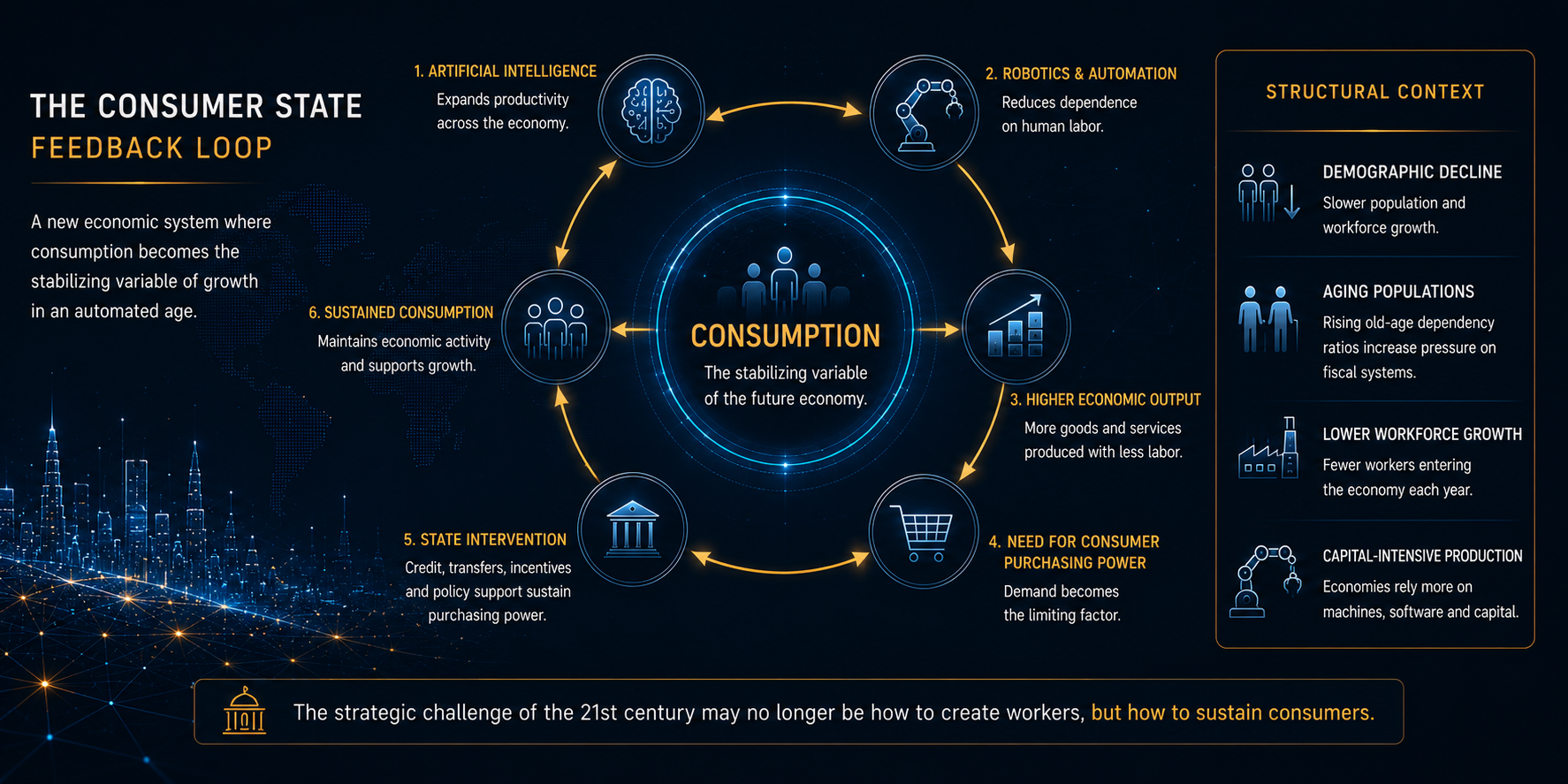
Figure 3 — The Consumer State Feedback Loop
A systems-level diagram showing how automation, purchasing power, consumption and state intervention reinforce one another within future economies.
Key Insight
In an automated economy, the consumer may become a strategic economic asset.
Taken together, these shifts may be adding up to something that doesn’t have a settled name yet. Call it, for lack of a better term, a form of welfare techno-nationalism — or, more simply, a sovereign bargain: closed borders, a state that owns or taxes a meaningful slice of automated production, and a citizenry whose income increasingly shows up as a dividend rather than a paycheck.
Not every piece of this is new. States fighting over strategic technology and resources is a pattern older than the nation-state itself, last seen in this form during the great mercantile rivalries of centuries past. Borders tightening once the economic case for staying open falls apart is just as familiar — nationalism rarely needed a new argument, only the disappearance of an old counter-argument.
What would be genuinely new is the third piece: a welfare system detached from labor at the scale of a major industrial power, not a small oil state. No advanced economy has ever handed out a citizenship dividend, rather than a wage, to a population in the hundreds of millions.
And that raises a question the bargain hasn’t answered yet. Wage-earning citizens built up political leverage precisely because their labor was scarce and necessary. A citizenry living off a dividend instead of a wage may not hold onto that same leverage — a pattern that’s shown up again and again in resource-rich states, where money that arrives without labor tends to come with less demand for political voice attached. Whether larger societies end up repeating that pattern, or instead spread the ownership of automated capital widely enough to dodge it, may be the question the sovereign bargain leaves hanging over the decades ahead.
Key Insight
The twentieth century centered economic organization on production; the twenty-first may center it increasingly on consumption.
For two centuries, population was one of the most reliable proxies for national power there was. More people meant more workers, more soldiers, more taxpayers, more output — the logic was almost embarrassingly simple: a bigger population made for a bigger economy.
Artificial intelligence may be wearing that logic down. As automation loosens the link to human labor, economic strength could increasingly hinge on a different mix of ingredients altogether: technological capability, strategic resources, energy availability, and the purchasing power of consumers.
None of that makes people irrelevant, though. Quite the opposite — they may matter more than ever, just for a different reason than before.
For generations, governments lost sleep over creating enough jobs for growing populations. The central challenge of the decades ahead could look completely different. How do nations sustain demand in economies that are increasingly automated? How do they hold onto prosperity in societies that are growing older and smaller at once? How do they keep consumption alive once labor stops being the main source of income?
Those questions may end up defining the geopolitical landscape of the twenty-first century.
For two hundred years, nations competed for workers. The next century may see them competing for consumers instead — building economies that no longer ask how to create jobs for their citizens, but how to create consumers for their machines.
That would be one of the most profound transformations in the history of economic power.